The need for reemergence of glass ionomer
Key Highlights
- Conventional glass ionomer cements may reduce recurrent caries and improve crown retention thanks to their fluoride release, self-bonding properties, and rigid support.
- Modern zirconia restorations and resin cements can present challenges with marginal fit, shrinkage, and debonding that may contribute to recurrent decay.
- New-generation glass ionomer materials offer improved handling, strength, wear resistance, and esthetics, making them a stronger option for crown cementation and restorative procedures.
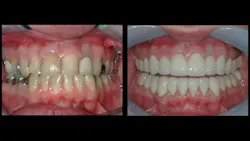
Each month, Dr. Gordon Christensen answers a question from readers about everyday dentistry.
Q: I am seeing dental caries far more often now than ever before, and I can’t understand why. The zirconia crowns do not seem to fit as well as the older porcelain or cast gold, and I am seeing caries on some of the margins. I seldom saw caries on large amalgam restorations, but I am certainly seeing caries on large composites after only a few years of service. Are the materials of today any different than those of the past? What can I do to reduce the challenges I am seeing?
A: As an augmentation to the previous Dental Economics article, “Can recurrent caries be prevented by glass ionomer,” from the March 2026 issue, I will expand on the use of glass ionomer. I have found a lack of understanding of this material in my many continuing education courses.
You are correct with your observations about crown margins. The milling machines could have more accuracy. Add this fact to the inaccuracy of current scanners when compared to vinyl or polyether, and the 60u or more spacing of virtual dies, and the result is less-than-optimum margin closure on crowns.
Additionally, as you have undoubtedly observed, some zirconia crowns are coming off in service, which almost never occurred with most of the previous cements.
In a major Clinicians Report Foundation (CR) in vivo study involving 119 practicing dentists and many different labs, now in its twelfth year of observation, we have observed significant challenges on the crowns that have come off. Staining and some initial caries can be observed on the crown intaglio surfaces after only a few months to a year of service (figure 1).
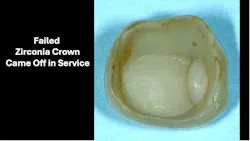
Use of resilient flexible resin cements placed under rigid and nonwearing zirconia is probably one of the reasons some of the crowns come off. Resin cement is flexible and has a lack of impact resistance compared to glass ionomer or zinc phosphate. That may be the reason some crowns come off when a patient inadvertently bites on a hard object like a seed or a bone.
When observing CR in vivo research and the research of others, we have some important conclusions relative to some of the zirconia challenges:
Lack of cariostatic properties: Very few crown cements and restorative materials have cariostatic properties, and many of them have significant shrinkage on setting. As a result of adding the shrinkage to the already open margins, this provides an ideal space for microorganisms to live and reproduce and caries to initiate.
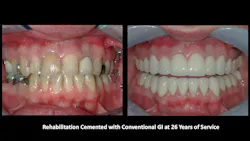
Older cements had more rigidity: Zinc phosphate and conventional glass ionomer cements were hard and rigid—not flexible. The crowns did not come off in service. They had resistance to the impact caused by biting a hard object (figure 2).
What currently available cements have the characteristics that will solve these two challenges?
Unfortunately, there is only one—conventional glass ionomer (GI).
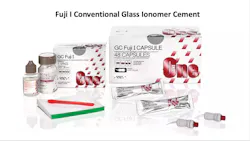
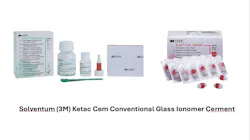
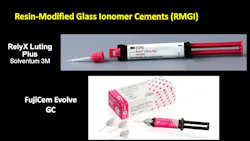
Do not mistake conventional GI (figures 3 and 4) with resin-modified glass ionomer (RMGI) introduced about 15 years later (figure 5). This material has similar characteristics to GI, somewhat better working characteristics, but lower fluoride release, slightly open margins as found by CR’s SEM research, and more crowns coming off in service than GI as reported by CR Clinical Evaluators. However, CR long-term in vivo research shows fewer crowns are released in service with RMGI than resin cements.
Overall glass ionomer uses
Conventional GI has been used globally since 1972 for restorations, cements, liners, bases, and other less popular techniques, but it has not been accepted well in the US. Why?
This article emphasizes only restorative materials and cements.
The original glass ionomer restorative materials were sticky, difficult-to-use, slow-setting, had only moderate strength, poor esthetic qualities, and wore significantly more than composite resin. Many dentists rejected them because of these properties.
The GI cements had cariostatic properties that reduced or almost eliminated caries around crown margins, but they infrequently produced unexpected and significant postoperative tooth sensitivity.
Despite these obvious negative factors, many dentists used them for their cariostatic and self-bonding characteristics. Fuji IX (GC America) became a favorite product for preventively oriented dentists using the ART procedure (atraumatic restorative technique).
After a few years of successful use, are the new GI restoratives better?
Yes, the new generation of GI restorative materials is significantly better than the previous generations. They have:
- Higher strength and fracture resistance because of refined glass formulations
- Better handling characteristics, less stringing when working, and they turn to putty in a few seconds after mixing
- Shorter setting time and less potential moisture challenges
- Improved wear resistance because of improved formulations
- Somewhat better esthetic characteristics, better translucence, smoother finish
- Better fluoride release and recharging capability
- Same or slightly better chemical chelation to tooth structure
Can conventional GI cements solve the stated challenges of current popular cements?
My educated prediction says yes! Numerous manufacturers are stating the same, and some are modifying their GI cements and preparing to promote new versions of them.
In the meantime, what can we do? During the 1970s, ’80s, and early ’90s, I personally placed thousands of porcelain-fused-to-metal crowns using conventional glass ionomer cement (Fuji I or Ketac Cem). I had occasional postoperative tooth sensitivity about which I will share how sensitivity can now be prevented. I am now removing some of the crowns necessitated by broken porcelain, objectionable color, or gingival recession. Almost none have caries and almost none have come off in service over a 30- to 60-year service period.
Eliminating or reducing postoperative sensitivity
I have published previously on the glutaraldehyde procedure in Dental Economics and other publications, so I will simplify the procedure here:
- Prepare the tooth using your normal procedure.
- Make sure the prep has adequate taper but is not overly tapered.
- Using the conventional two-day crown procedure or a one-day procedure, place 5% glutaraldehyde/35% HEMA solution on the tooth prep at the time of cementation.
- Example products are MicroPrime, G5, Gluma, Glu Sense, and others.
- Two one-minute applications are mandatory to penetrate to the pulp. Avoid getting the solution on the gingival tissues.
- Suction the glutaraldehyde solution from the tooth surface. Don’t blow it off to avoid gingival irritation.
- Seat the crown with GC Fuji I, Solventum 3M Ketac Universal Aplicap, or Ketac Universal conventional glass ionomer cement.
- Enjoy a desensitized and disinfected crown restoration with the potential of proven long-term, nonproblematic service.
Summary
I have identified specific weaknesses and strengths of glass ionomer materials for crown cementation and for direct tooth restorations and have stated the advantages of the new generation of GI over the older generation. I encourage dentists to overcome most of the known previous problems with glass ionomer by using the suggestions in this article.
Editor's note: This article appeared in the September 2026 print edition of Dental Economics magazine. Dentists in North America are eligible for a complimentary print subscription. Sign up here.
About the Author
 Gordon J. Christensen, DDS, PhD, MSD
Gordon J. Christensen, DDS, PhD, MSD
Gordon J. Christensen, DDS, PhD, MSD, is founder and CEO of Practical Clinical Courses and cofounder of Clinicians Report. His wife, Rella Christensen, PhD, is the cofounder. PCC is an international dental continuing education organization founded in 1981. Dr. Christensen is a practicing prosthodontist in Provo, Utah.