Why AI is scrolling your social media before patients ever do
Key Takeaways:
● Why AI assistants are now reading your practice's social media profiles the same way they read your website, and what that means for how patients find you.
● Why chasing viral posts is no longer the goal, and what actually gets your practice noticed by AI search tools.
● What to post, how to get past camera shyness, and which content formats AI consistently favors.

For years, your practice's social media was mostly about patients scrolling and, if you were lucky, sharing a post with a friend. That's not the whole picture anymore. AI assistants like ChatGPT, Gemini, and Perplexity are now pulling information from your Instagram captions, Facebook posts, and Google Business Profile to answer questions like "who's a good family dentist near me" or "which dentist takes anxious patients." If that sounds like a big shift, it is.
Wait, doesn't going viral still matter?
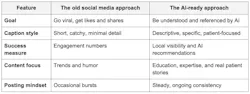
Not the way it used to. A few years ago, the goal of dental social media was reach. Get enough likes, get shared enough times, and new patients would find you. Now, AI-powered search is changing the math. A post with 12 likes and a genuinely detailed, helpful caption can carry more weight in AI recommendations than a post with 10,000 views and no real substance behind it.
This is a hard mental shift for a lot of dental teams. You've been trained to think in terms of engagement metrics. But AI assistants aren't counting likes. They're reading your captions, your bios, and your practice descriptions to figure out what you actually do and who you actually serve. In fact, your Instagram posts matter now for reasons that have nothing to do with virality. It's less about getting seen by a lot of people and more about being understood correctly by a system that recommends you to the right people.
Social media is now a local ranking signal
This might be the biggest change of all. Social media used to feel like a separate channel from your website and your local search rankings. Not anymore. Active, consistent social media activity now works alongside your local SEO efforts to build the kind of online authority that both Google and AI assistants reward.
Think of it like this. When AI has to choose which practice to recommend, it's looking for signals of credibility and activity across your whole online footprint, not just your website. Consistent, detailed social posts function almost like small pieces of evidence that your practice is active, trustworthy, and genuinely engaged with patients. That's a meaningfully different job for social media than it had five years ago, and it's a big reason AI is transforming SEO strategy for dental practices across the board.
Here's a simple way to picture the shift between the old approach and the new one.
What should you actually post?
If virality isn't the goal anymore, what is? Here's where to start.
- Patient education posts. Explain a procedure, answer a question you hear often, or break down what happens during a first visit. Detailed, plain language captions help both patients and AI understand your expertise.
- Team spotlights with real detail. Instead of "Meet Sarah!" try a few sentences about her role, how long she's been with the practice, and what patients love about her.
- Behind-the-scenes content. Show your office culture, your technology, or a typical day. This builds trust and gives AI more context about how your practice operates.
- Community involvement. Sponsorships, school visits, and charity events give AI real signals about your local presence and values.
- Before-and-after case stories with context. Don't just post the photo. Explain the treatment, the timeline, and why it worked for that patient.
For a deeper list of ideas you can rotate through all year, this collection of dental marketing social media ideas is a great place to build out a content calendar.
Getting over the camera shyness
Let's be honest. A lot of dentists and office managers avoid social media because they don't love being on camera. That's completely normal, and it's worth pushing through anyway. You don't have to be a natural performer to post effectively.
Start small. A short clip of you answering one common patient question is much easier than trying to record a polished, produced video. Keep your first few posts under 30 seconds. Practice saying the same thing two or three times before you hit record, and don't worry about getting it perfect. Patients respond to authenticity far more than polish. If being on camera still feels like too much, let your team take turns, or start with photos and written captions before working up to video. If you'd rather hand this off entirely, a managed dental social media service can help keep your content consistent while you focus on patients.
What types of posts does AI actually like?
AI systems consistently favor a few specific qualities in social content, and once you know them, they're not hard to build into your routine.
- Specific, descriptive captions. Vague captions give AI nothing to work with. Specific ones, like naming a treatment, a symptom, or a location, give AI something concrete to reference.
- Consistency over time. A steady stream of posts signals an active, trustworthy practice. Sporadic posting sends a weaker signal.
- Original, first-person insight. Sharing your own clinical perspective, even briefly, reads as more credible than generic tips.
- Location-specific language. Mentioning your city or neighborhood naturally helps AI connect your content to local searches.
- Text-supported video. Captions and on-screen text that explain what's happening in a video help AI interpret content it otherwise can't fully "watch."
This kind of detailed, structured content is exactly what's covered in how to teach AI to find and recommend your dental practice.
Video is becoming non-negotiable
Video deserves its own spotlight here. Patients are far more likely to watch a short video than read a paragraph, and AI tools increasingly favor video content that comes with strong text support. The good news is that creating video has gotten dramatically easier and less expensive. New AI-assisted video tools mean practices without a production budget can still put out high-quality educational and social video content without hiring a film crew.
Even a simple video, a quick office tour, a team introduction, or a patient answering a common question, can do a lot of heavy lifting when it's paired with a clear, descriptive caption.
Bringing it all together
AI has changed the rules for dental social media, and the practices that adapt now will have a real head start. It's no longer about chasing likes or hoping something goes viral. It's about showing up consistently, writing detailed and specific captions, and giving both patients and AI real information to work with. Start with one or two changes this month, maybe a more detailed caption style or your first short video, and build from there.
FAQ
Q: Why does AI care about my practice's social media?
A: AI assistants pull information from social platforms to answer patient questions and make recommendations. Detailed, text-rich posts give AI more to reference when suggesting a dentist.
Q: Do I still need a lot of followers or likes for AI to notice my content?
A: Not really. AI focuses on the substance and consistency of your content rather than follower counts or engagement numbers.
Q: What's the easiest way to start posting video if I'm camera shy?
A: Start with a single, short answer to a common patient question, under 30 seconds, and don't aim for perfection. Authenticity matters more than polish.
Q: How often should my practice post to help with local rankings?
A: Consistency matters more than volume. A steady weekly rhythm signals activity and trustworthiness better than occasional bursts of posting.
Q: Can AI actually understand my videos and photos?
A: Not directly. AI mostly reads the text around your visuals, so descriptive captions and on-screen text are essential for helping AI understand your content.
About the Author
Danielle Caplain
Danielle Caplain is a copywriter at My Social Practice, where she crafts compelling, SEO-friendly content that helps dental practices grow their online presence and connect with patients. My Social Practice is a dental marketing company that provides comprehensive dental marketing services to thousands of practices across the United States and Canada.