AI SEO: Why your dental practice needs to be mentioned (not just found)
Key Highlights
- Why patients are abandoning traditional Google searches in favor of AI-powered conversations, and how this fundamentally changes your practice's visibility strategy
- The specific steps to optimize your dental practice for AI recommendations, including content structure, Google Business Profile optimization, and strategic blogging techniques
- How to track whether AI assistants like ChatGPT are actually mentioning your practice, plus actionable steps you can take today to improve your AI visibility

Picture this: Sarah needs a dentist. Instead of typing "dentist near me" into Google, she opens ChatGPT on her phone and asks: "I need a dentist who takes Delta Dental, has evening hours, and is good with anxious patients. What do you recommend in Austin?"
ChatGPT responds with a dental practice by name, complete with details about their services, insurance acceptance, and patient approach.
Did your practice make that list? There's no page to scroll to. No ads to click. You're either mentioned, or you're invisible.
This shift is happening faster than most dental professionals realize. According to recent industry reports, ChatGPT processes 2.5 billion prompts daily, with healthcare queries making up a significant portion. Research shows that nearly 40% of younger patients already use AI tools for healthcare searches, and that number continues to climb.
When AI recommends a dental practice, patients trust these recommendations as objective, unbiased advice, not as paid advertisements or SEO-optimized listings.
What is AI SEO?
AI SEO is simply this: Making sure AI assistants know about your practice and recommend it by name when patients ask relevant questions.
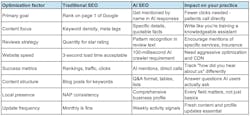
Traditional SEO asks: "How do we rank on Google's first page?" AI SEO asks: "How do we get ChatGPT to recommend us by name?"
Here's a concrete example:
Without AI SEO: Patient: "I need a root canal in Portland." ChatGPT: "For root canals, you should look for an endodontist. Check Google Maps for endodontists near you."
With AI SEO: Patient: "I need a root canal in Portland." ChatGPT: "For root canals in Portland, I'd recommend Portland Endodontics on SW Broadway. Dr. Jennifer Chen specializes in pain-free root canals using advanced microscopy, accepts most major insurance, and offers sedation options."
The alphabet soup of AI optimization
You’ve probably heard multiple times to optimize your LLMO, enhance your GEO, or revolutionize your AEO. Here's what dental professionals actually need to know:
These are all variations of the same core goal: making your practice visible wherever patients are searching, whether that's Google, ChatGPT, Gemini, Claude, or whatever AI tool launches next week.
Think about it this way: Twenty years ago, businesses named themselves "AAA Dental" just to appear first in the Yellow Pages. Then came "website optimization," which evolved into "Google optimization," and now we have a dozen terms for optimizing across different AI platforms.
The terminology explosion happens because the technology keeps evolving, but your goal remains unchanged: be visible where patients look for dental care.
Whether your agency calls it LLMO for dentists, GEO, AI SEO, or their own proprietary term, don't get paralyzed by the jargon. Focus on the fundamentals, and you'll be optimized for all of them.
Why your beautiful website doesn't matter as much anymore
Your expensive website redesign is now becoming less important for attracting new patients. When AI provides comprehensive answers directly in the chat interface, patients often never visit your website at all.
Here's why: When AI provides comprehensive answers directly in the chat interface, patients often never visit your website at all. They get the information they need, make their decision, and call your practice, all without clicking a single link.
This doesn't mean your website is worthless. It means its role is changing. Your website is no longer the first impression; it's the credibility validator. It needs to exist, it needs to be professional, but more importantly, it needs to feed AI systems the right information.
Think of your website now as the backstage crew rather than the lead actor. It's working behind the scenes to ensure AI systems have accurate, detailed information about your practice to share with patients.
How does AI actually build its answers?
Understanding how AI constructs responses about dental practices helps you optimize effectively. AI systems don't randomly guess; they synthesize information from multiple sources:
1. Google Business Profile data
Your Google Business Profile is the primary source AI engines consult when building local business recommendations. This includes your hours, services, reviews, photos, posts, and Q&As. AI treats this as your practice's source of truth.
2. Review aggregation patterns
AI analyzes patterns across hundreds of reviews. If 50 reviews mention "gentle with kids" and "amazing with anxious patients," AI learns these are your strengths and mentions them in recommendations.
3. Website content structure
AI crawls your website looking for specific information: services offered, insurance accepted, dentist bios, technology used, patient policies. Clear, structured content gets understood and repeated.
4. Local citations and mentions
Every mention of your practice online contributes to AI's understanding. Local news articles, healthcare directories, dental association listings, community event sponsorships, all build your AI presence.
5. Social media signals
Your social media presence now directly impacts your search visibility. AI systems recognize active practices with engaged communities and factor this into recommendations.
6. Blog content and expertise
Regular, informative blog posts about dental topics establish your practice as an authority. AI systems recognize and reward expertise, often quoting from well-written dental blogs when answering patient questions.
Building your AI visibility foundation
Now that you understand how AI constructs its recommendations, let's build your practice's AI presence systematically. Think of this as a three-layer cake: your website provides the base, your content adds flavor, and your Google Business Profile becomes the showcase that catches everyone's attention.
Layer 1: Website structure that AI understands
Your website needs to speak AI's language. This means transforming vague marketing copy into specific, extractable information:
Service pages example: Instead of: "We offer dental implants using the latest technology." Write this: "Sunshine Dental provides single-tooth implants starting at $3,200, using Nobel Biocare implants with a 98% success rate. Dr. Martinez has placed over 1,500 implants since 2018."
Don't forget speed - AI systems have strict requirements. If your site doesn't load within 100 milliseconds for AI crawlers, they might skip it entirely.
Layer 2: Content that establishes authority
Your blog isn't just patient education anymore; it's AI training material. Every well-written post teaches AI systems that you're the local expert on specific dental topics. Focus on answering real patient questions with detailed, structured content that includes headers formatted as questions, lists, tables, and FAQ sections.
Publishing twice monthly minimum establishes pattern recognition. AI systems notice consistency and reward it with more frequent mentions. Consider implementing comprehensive marketing strategies to ensure your content reaches both humans and AI.
Layer 3: Your Google Business Profile as command central
Your Google Business Profile has evolved from a simple listing to AI's primary information source about your practice. It's the first place AI looks when building local recommendations, making it your most powerful AI optimization tool.
Complete every field meticulously - from service categories and insurance plans to accessibility features and parking details. Your Q&A section directly feeds AI responses, so proactively add detailed answers about prices, procedures, and policies. Respond to reviews within 48 hours, naturally mentioning services and keywords in your responses.
Tracking your AI visibility success
Traditional analytics won't reveal if ChatGPT recommends your practice. You need a new measurement approach that captures AI-driven patient acquisition:
Weekly AI audit: Set aside 15 minutes each week to test different AI platforms. Ask the questions your ideal patients would ask. Document whether your practice appears, what details are included, and which competitors are mentioned. Track changes over time to spot trends.
Update patient intake: Add "AI assistant (ChatGPT, Gemini, etc.)" to your referral source options. Train your team to specifically probe when patients say they "found you online" - many AI-referred patients don't realize that's how they found you.
Watch for AI indicators: Notice increases in direct phone calls bypassing your website, more specific procedure inquiries, and patients mentioning detailed information about your practice they couldn't have found on your homepage.
Understanding the key indicators of organic search success helps you measure progress across both traditional and AI-powered search.
Want to see if you're currently visible to AI? Get your personalized AI recommendation audit here. For dental professionals ready to dive deeper into optimization strategies, this comprehensive guide "AI SEO for Dentists" breaks down every aspect.
Act now: The practices who move first win
The AI revolution in dental patient acquisition is not coming, it's here. Every day you wait, your competitors gain ground in AI recommendations. But here's the opportunity: Because most practices haven't even started, moving now gives you a massive advantage.
Implementing AI SEO doesn't require throwing away everything you've built. It means enhancing your existing digital presence with structured information, comprehensive content, and strategic optimization that helps AI systems understand and recommend your practice.
Take the first step today by auditing your current AI visibility. Test what happens when you ask ChatGPT about dental services in your area. If your practice isn't mentioned, you now have the roadmap to change that.
FAQ
Q: How long does it take to see results from AI SEO efforts? A: Initial improvements typically appear within 60-90 days, with consistent recommendations across platforms taking 3-6 months.
Q: Do I need different strategies for ChatGPT versus other AI tools? A: Focus on comprehensive information rather than platform-specific tactics. Good AI SEO works across all platforms.
Q: Will AI SEO replace traditional SEO for dental practices? A: No, AI SEO builds upon traditional SEO. AI systems use traditional search signals as quality indicators.
Q: What's the minimum budget needed to implement AI SEO? A: Start with no budget by optimizing your Google Business Profile and website content.
Q: How do I track if patients are finding us through AI recommendations? A: Update intake forms to include "AI Assistant/ChatGPT" as a referral source and train staff to ask new callers how they heard about you.
About the Author
Danielle Caplain
Danielle Caplain is a copywriter at My Social Practice, where she crafts compelling, SEO-friendly content that helps dental practices grow their online presence and connect with patients. My Social Practice is a dental marketing company that provides comprehensive dental marketing services to thousands of practices across the United States and Canada.