Why “authority” is the most important word in dental marketing right now
Key Highlights
- What "authority" actually means in the digital world, and why it has nothing to do with your years of experience or the letters after your name.
- How tools like ChatGPT, Google Gemini, and Perplexity decide which dental practices to recommend, and the specific signals they use to make that call.
- Three straightforward actions your practice can start taking this week to build stronger digital authority and show up when AI points patients your way.

Think about how you would describe the most respected dentist in your market. Decades of experience. Loyal patients. A reputation built word by word, referral by referral. That kind of authority is real. It is earned. And no algorithm can take it away.
But here is the challenge: AI search tools cannot see any of it.
When a potential patient opens ChatGPT and types "Who is the best dentist near me?" or asks Google Gemini for a recommendation, the AI is not checking credentials, scanning diplomas, or reading your bio. It is doing something entirely different. It is scanning the internet for patterns, signals, and data points that help it determine whether your practice is credible, active, and trustworthy online.
If those signals are weak, or missing entirely, AI will recommend someone else. Even if you are objectively the better clinician.
This is the new reality of AI for dental SEO, and understanding it is the first step toward making sure your practice gets found.
So what does "authority" actually mean in the age of AI?
In simple terms, digital authority is how much the internet trusts your practice.
Think of it this way. When someone is new to a neighborhood and asks a neighbor for a dentist recommendation, that neighbor thinks about who they have heard good things about, who other people seem to trust, and who has a visible, positive reputation in the community. They are not pulling up transcripts. They are going off signals.
AI works the same way, except its "neighborhood" is the entire internet. It looks at your website, your Google Business Profile, your patient reviews, your social media presence, and your listings across directories to build a picture of who you are. The stronger and more consistent that picture is, the more authority you carry with AI.
This is why dental SEO in the AI era is no longer just about having the right keywords on your website. It is about being visible, active, and consistent across every digital touchpoint a patient might encounter before they ever call your office.
Why this is different from how patients used to find you
Not long ago, new patient acquisition was simpler. Someone moved to town, asked a coworker for a recommendation, and booked an appointment. Or they searched Google, scrolled through the map results, and called the practice with the most reviews.
Both of those channels still exist. But there is a third one now, and it is growing fast.
Patients are increasingly turning to AI tools before they ever visit a website. They type conversational questions into ChatGPT, ask Gemini for local recommendations, or use Perplexity to compare their options. And when they do, the practices with the strongest digital authority are the ones that show up.
This is not a future concern. It is happening right now. And the practices building their authority today will have a significant head start over those who wait.
What AI is actually looking at when it evaluates your practice
Here is a simple breakdown of the main signals AI uses to assess your authority. Understanding these makes it much easier to know where to focus your effort.
Your Google Business Profile
Your Google Business Profile, also called your GBP, is the listing that appears on Google Maps and in local search results. It shows your name, address, phone number, hours, services, photos, and reviews. AI tools, especially Google Gemini, pull heavily from this listing when generating local recommendations. A complete, accurate, and regularly updated profile tells AI that your practice is active and legitimate. A neglected one sends the opposite message, even if your schedule is packed.
Your Google reviews
Reviews are one of the most powerful authority signals available to your practice. AI looks at how many you have, how recent they are, and whether you respond to them consistently. A steady stream of fresh reviews signals an active, patient-focused practice. A wall of old reviews with no new additions in six months signals something else entirely. Recency matters just as much as volume when it comes to local search visibility.
Your website content
Your website functions as a reference book for AI. When a search tool wants to know what procedures you offer, whether you accept certain insurance types, or what your location serves, it looks at your website for clear answers. Pages that answer patient questions directly and specifically are far more useful to AI than pages filled with vague, generic language about "exceptional care."
Your listings across the web
Wherever your practice name, address, and phone number appear online, they need to match. Yelp, Healthgrades, your dental association profiles, social media pages, and any other directory that lists your practice should all show the same information. Inconsistencies create confusion for AI and quietly erode your authority without anyone on your team noticing.
The big difference between clinical credibility and digital authority
Here is the clearest way to think about it. Clinical credibility is what your existing patients know about you. Digital authority is what AI can find out about you.
Both matter. But only one of them influences whether AI recommends your practice to someone who has never heard of you before.
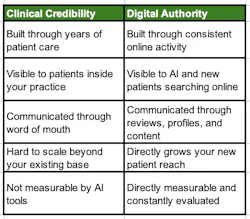
The goal is not to choose one over the other. The goal is to make sure your digital presence reflects the quality of care you already deliver. Right now, for many dental practices, there is a gap between those two things. And that gap is costing them new patients.
Three things you can do this week to start building authority
You do not need to overhaul your entire marketing strategy overnight. Start with these three foundational actions.
- Audit your Google Business Profile. Log in and check that your hours, address, phone number, services, and photos are current and complete. If you have not posted an update in the last 30 days, add one. A single photo or practice update is enough to signal activity.
- Create a simple system for collecting Google reviews. Ask patients for a review within a day or two of their appointment, when the experience is fresh. The difference between a practice with 50 reviews and one with 300 often comes down to nothing more than a consistent, simple ask.
- Check your name, address, and phone number across your top directories. Search your practice name and make sure the information on Google, Yelp, Facebook, and Healthgrades all match exactly. A phone number mismatch or an old address can chip away at your authority in ways that are easy to fix once you spot them.
These are not technical tasks that require a marketing background. They are habits. And they directly affect whether AI sees your practice as an authority or overlooks it entirely.
Understanding how dental reputation management feeds into your overall authority strategy can help you see how these pieces connect into a larger picture of practice visibility.
Building digital authority means making sure every place AI looks for information about your practice tells a consistent, credible, and active story. The good news is that the steps to get there are straightforward, and starting now puts you well ahead of most practices in your market. Choose one of the three actions above and put it in motion this week. Your future patients are already searching.
FAQ
Q: What is digital authority for a dental practice?
A: Digital authority is how trustworthy and credible your practice appears across the internet, based on signals like your Google Business Profile, patient reviews, website content, and directory listings. AI search tools use these signals to decide whether to recommend your practice to potential patients.
Q: Why does AI search use reviews instead of credentials to evaluate dentists?
A: AI tools cannot read diplomas or assess clinical skill. What they can read is publicly available data, and reviews are one of the richest sources of trust signals available. Volume, recency, and how consistently you respond to reviews all factor into how AI ranks your practice locally.
Q: How is authority in AI search different from traditional SEO?
A: Traditional SEO focused heavily on website keywords and backlinks. Authority in AI search is broader. It includes your Google Business Profile activity, your review patterns, your presence across directories, and how consistent your information is everywhere it appears online.
Q: How long does it take to build digital authority for a dental practice?
A: You can begin seeing meaningful improvement within a few months of consistent effort. Practices that actively request reviews, post regular updates to their Google Business Profile, and maintain consistent directory information tend to build authority faster than those who treat it as a one-time setup.
Q: Can my practice build authority without hiring a marketing team?
A: Absolutely. Many of the highest-impact actions, checking your profile for accuracy, asking patients for reviews, and verifying consistent listings, are team habits rather than technical tasks. That said, partnering with a dental marketing company that understands AI search can accelerate results significantly.
About the Author
Danielle Caplain
Danielle Caplain is a copywriter at My Social Practice, where she crafts compelling, SEO-friendly content that helps dental practices grow their online presence and connect with patients. My Social Practice is a dental marketing company that provides comprehensive dental marketing services to thousands of practices across the United States and Canada.