Why your dental SEO results take longer than you think (and what's happening behind the scenes)
Key Highlights
- Why Google intentionally makes you wait before rewarding your SEO efforts with higher rankings
- The specific signals search engines evaluate over months (not days) that determine your practice's credibility
- What's actually happening during those first 6-12 months when you see minimal results, and how to set realistic expectations for your team

You launched a brand-new website three weeks ago. You've been publishing blog posts. Your team is posting consistently on social media. But when you Google "dentist near me," your practice is nowhere to be found.
So you call your marketing company and ask the obvious question: "When will this start working?"
The answer nobody wants to hear? Probably not for another five to seven months.
It's frustrating. You need patients now, not next year. But understanding why dental SEO takes time isn't just about managing expectations. It's about making smarter decisions with your marketing budget.
The internet doesn't reward speed, it rewards patience
Think about it from Google's perspective. Their entire business model depends on delivering accurate, helpful search results. If people search for "emergency dentist" and get spammy, low-quality websites, they'll stop using Google altogether.
That's why search engines don't just look at what your website says. They look at what the internet says about your website. And building that reputation takes time.
Consider two dental practices competing for the same search terms in the same city. Dr. Martinez has been in practice for 15 years with a website that's been live since 2010. Dr. Chen just opened her practice last month with a brand-new website.
From Google's perspective, Dr. Martinez has spent more than a decade accumulating digital credibility. Years of patient reviews. Hundreds of blog posts indexed by search engines. Links from local news articles, community organizations, and dental associations. Social media profiles with thousands of followers built over time.
Now imagine if Dr. Chen could bypass all that history with a few quick SEO tricks. It wouldn't be fair to Dr. Martinez, and more importantly, it wouldn't serve patients well. Google's algorithm protects established, legitimate practices from being displaced by newcomers gaming the system.
This is exactly why shortcuts don't work. Google's algorithm updates are specifically designed to catch manipulation. Practices that try to cheat the system often end up worse off than when they started, with penalties that take even longer to recover from.
What Google is actually measuring while you wait
Search engines use a framework called E-E-A-T: Experience, Expertise, Authority, and Trustworthiness. These aren't just marketing buzzwords. They represent real signals that take months to build legitimately.
Experience means your content demonstrates real-world knowledge. Patient testimonials, detailed procedure explanations, and case examples signal that you actually do this work every day.
Expertise means your content is written by someone who knows dentistry inside and out. Google looks for credentials, depth of knowledge, and accuracy. This is where dental brand mentions start to matter, as third-party sources citing your practice builds this signal over time.
Authority means other reputable sources reference your practice. Links from local news outlets, dental associations, and community organizations tell Google that your practice matters in your market. But nobody earns dozens of high-quality backlinks overnight.
Trustworthiness means your online presence matches your real-world reputation. A secure website, authentic patient reviews, and consistent business information across the web all contribute to this signal. Google reviews play a particularly important role here, as they provide social proof that real patients trust your practice.
Each of these signals requires time to build. You can't manufacture 10 years of authority in 30 days.
The hidden work happening in months 1–6
When you don't see immediate results from SEO, it's easy to assume nothing is happening. But there's actually intensive work occurring behind the scenes during those first six months.
Your SEO team (or if you're doing it yourself, you) should be focused on:
Technical foundation (months 1-2): Fixing site speed issues, improving mobile optimization, implementing schema markup, securing your website with HTTPS, and ensuring search engines can properly crawl and index your pages. This work is invisible to patients but critical for rankings.
Content strategy (months 2-4): Creating service pages, location pages, and blog content that targets the specific search terms your ideal patients use. This includes developing AI-optimized content that works for both traditional search engines and newer AI-powered search platforms like ChatGPT and Perplexity.
Authority building (months 3-6): Getting listed in relevant dental directories, building citations across the web, and beginning outreach for backlinks from local organizations and industry publications.
During this time, you might see small improvements. A few more website visitors. Better rankings for less competitive, long-tail keywords. But the big results, the ones that actually move the needle for your practice, typically don't appear until months 7-12.
Why SEO becomes more valuable over time
Here's what makes the wait worth it: once you've built that SEO foundation, it becomes remarkably durable and cost-effective.
Compare SEO to paid advertising. With Google Ads or Facebook ads, you get immediate visibility. Run an ad campaign, and you'll see patients booking appointments within days. But the moment you stop paying, those patients stop coming. And as more practices compete for the same ad space, costs keep climbing.
SEO works the opposite way. It requires patience upfront, but the returns compound over time. A blog post you publish today might generate patient inquiries for years. The authority you build doesn't disappear when you reduce your marketing budget.
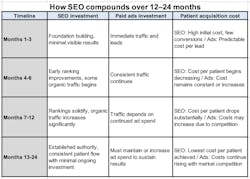
The practices that win long-term are those that recognize SEO as an asset that appreciates in value, while advertising is an expense that only works while you're paying for it.
What you should actually be doing while you wait
If SEO takes six to twelve months to produce meaningful results, what do you do in the meantime? The smart approach isn't choosing between SEO and other marketing channels. It's using multiple strategies strategically.
Start SEO immediately. Every month you delay pushes results further out. The best time to start was a year ago. The second best time is today.
Use paid ads as a bridge, not a foundation. Google and Facebook ads can generate patients while your SEO foundation builds. Just budget for them as a temporary expense, recognizing that you're working toward reducing reliance on paid advertising over time.
Build your review profile now. Patient reviews on your Google Business Profile support both your reputation and your local SEO. This is something you can improve immediately, and it directly impacts how quickly you see SEO results.
Integrate social media with SEO strategy.Social media and SEO are no longer separate in how search engines evaluate your practice. Your social presence contributes to your overall digital authority.
Plan for the reality of modern search. With AI-powered search platforms changing how patients find dentists, your SEO strategy needs to work for both traditional Google search and newer platforms like ChatGPT and Perplexity that answer questions directly.
The real cost of shortcuts and quick fixes
Every few years, a marketing company claims they've cracked the code for instant SEO results. They promise first-page rankings in weeks instead of months. Sometimes they even deliver, temporarily.
But Google's algorithm is constantly evolving specifically to catch these tactics. What works today gets penalized tomorrow. Practices that use black-hat SEO techniques often find themselves worse off than when they started, with Google penalties that can take 12-18 months to recover from.
The recovery timeline from a penalty is actually longer than it would have taken to build legitimate authority from the start.
The bottom line
SEO takes time because Google designed it that way. The algorithm rewards practices that build genuine authority through consistent, quality work over months and years. Trying to skip ahead doesn't work. It just makes things worse.
But here's the payoff: a solid SEO foundation generates patients at a fraction of the cost of paid advertising, and those results persist even when you reduce your investment. In an industry where ad costs keep climbing and competition intensifies, that's an asset worth building.
Start your SEO work now. Use advertising strategically while you build. And trust that the practices winning in search five years from now are the ones who committed to the process today.
FAQ
Q: Can I realistically speed up my dental SEO timeline?
A: You can optimize the process but not fundamentally shortcut it. Working with experienced dental SEO professionals, ensuring your website is technically sound, and producing high-quality content consistently can help you build authority as efficiently as possible. However, tactics promising dramatically faster results typically involve manipulation that Google will eventually penalize. The fastest legitimate path is starting immediately and staying consistent.
Q: Why does SEO take longer for new practices than established ones?
A: Google evaluates domain age and history as trust signals. Established practices have years of content, backlinks, reviews, and consistent online presence that new practices simply haven't had time to accumulate yet. A practice that's been operating since 2010 with an active website has built credibility that can't be replicated overnight. New practices need to demonstrate consistency and quality over time before Google grants them the same authority.
Q: What's the biggest mistake practices make during the SEO waiting period?
A: Giving up too early. Many practices invest in SEO for three or four months, don't see dramatic results, and conclude it's not working. They pull their investment right before they would have started seeing returns. The second biggest mistake is trying multiple marketing companies within the first year, restarting the timeline each time they switch. Consistency and patience are essential for SEO success.
Q: How do I know if my SEO investment is actually working before I see big results?
A: Track leading indicators in months 1-6: increased indexed pages in Google Search Console, improved technical scores from site audits, growing keyword rankings (even if not on page one yet), increased organic traffic month-over-month, and improvements in average position for target keywords. These metrics show progress even before you see significant patient inquiries. Regular reporting from your SEO provider should show these incremental improvements.
Q: If SEO takes so long, why not just stick with paid advertising?
A: Both have their place, but relying solely on ads creates long-term vulnerabilities. Ad costs are rising significantly, particularly in competitive dental markets. When you stop paying for ads, patient inquiries stop immediately. SEO becomes more cost-effective over time while ads become more expensive. The ideal strategy for most practices is using ads for immediate needs while building SEO for long-term stability and reduced patient acquisition costs.
About the Author
Danielle Caplain
Danielle Caplain is a copywriter at My Social Practice, where she crafts compelling, SEO-friendly content that helps dental practices grow their online presence and connect with patients. My Social Practice is a dental marketing company that provides comprehensive dental marketing services to thousands of practices across the United States and Canada.