2026 Yelp update for dentists: Should Yelp be part of your marketing mix next year?
Key Highlights
- AI is reshaping local search visibility: Google’s AI Overviews are reducing clicks to third-party platforms like Yelp, changing how patients discover and choose dental practices online.
- Yelp adapts with new AI features—but faces challenges: While Yelp’s AI tools improve personalization and ad targeting, its visibility still depends heavily on Google and regional search behavior.
- Yelp still matters for many practices: In markets where Yelp ranks highly, maintaining strong reviews and considering Yelp Ads can drive qualified patient leads and complement other digital marketing efforts.
The truth about Yelp in 2025 is complicated. For some dental practices, Yelp remains an important driver of patient inquiries. For others, it is an afterthought—if it appears in the marketing conversation at all. Meanwhile, the rise of AI-driven search has reshaped how patients discover local businesses, and Yelp is not immune.
For some dental offices, the marketing mix that works in 2026 will absolutely include updated listings on Yelp and will even spend significant funds on Yelp’s ad options. Others will find Yelp to be an even bigger waste of internet space than ever.
The AI heavyweight elephant in the room
Any digital platform discussion today must start with AI. Google’s AI Overviews—those AI-generated snippets now appearing at the top of search results—are transforming the patient discovery process. A recent Semrush analysis of more than 10 million queries showed that 13.14% of searches in March 2025 triggered an AI Overview, up from 6.49% in January 2025.1 Navigational queries (the kind where people search for “Yelp dentist [city]”) roughly doubled in that same time frame, from 0.74% to 1.43%.2 That shift matters. If a patient’s question about dental implants gets answered by an AI summary before they ever see the blue links, where does that leave platforms like Yelp (figure 1)?
Publishers in other industries are feeling this sting. A study covered by The Guardian showed that some sites lost up to 80% of their search traffic when their links sat beneath an AI summary.3 While the study focused on news outlets, the principle applies everywhere: fewer clicks go to third-party sites when Google (or ChatGPT) supplies the answer directly.
Roughly two-thirds of all Google searches end with users browsing elsewhere on Google according to a Pew study cited in an article on Search Engine Land.4 Organic rankings no longer guarantee visibility. For Yelp, the implication is clear. Its days of coasting on first-page prominence are numbered. If AI Overviews keep expanding, the percentage of patients who ever click into a Yelp directory listing could shrink.
Additional reading: 5 marketing list management musts for dental offices
Yelp’s counterpunch
To its credit, Yelp is not standing still. The company has rolled out a slate of AI-driven features: personalized feeds, smarter ad optimization, AI-powered Review Insights, and expanded “personalized discovery tools.”5 Yelp wants to position itself as a discovery engine in its own right, rather than relying on Google referrals.
But let’s be honest. Patients were not rushing to install the Yelp app in 2025 at higher rates, nor are they likely to do so in 2026. For many people, Yelp shows up because Google decided to surface it, not because they tapped the Yelp icon on their phone. Apple users still see Yelp data in Apple Maps listings, and there’s no sign that this is changing anytime soon. Navigational searches for “Yelp + dentist” still happen, but they are a niche behavior compared to the juggernaut of “dentist near me.”
So, Yelp’s AI rollout looks less like a bold leap forward and more like an insurance policy. If Google starves off some of its oxygen, Yelp hopes to squeeze more value out of the traffic it does retain.
What hasn’t changed
Despite AI disruption, some fundamentals remain steady. Yelp still boasts a little more than half a million small businesses that pay for ads on its platform, and Yelp businesses have more than 308 million cumulative reviews.6 That is a vast amount of consumer input shaping perceptions of local businesses. Dentists would be foolish to write off Yelp as a has-been.
Yelp users are not idly scrolling. They are looking for businesses, meaning that they are pretty far down the buying cycle. They have likely done their homework about their dental problems on Google AI Mode or ChatGPT and are weighing one dental practice against another with a treatment already in mind.
Having said that, dentists with poor reputations and limited review history on Yelp need to beware.
According to Yelp’s newsroom Fast Facts, just 54% of businesses enjoy a five-star rating, while 18% languish at one star.6 That spread means reputations are fragile. For dental practices with only a handful of reviews, one unhappy patient can send an average tumbling into unflattering territory. Also unchanged is Yelp’s bothersome and morally questionable practice of hiding reviews in their “Not Recommended” section. Research shows that Yelp reviews often migrate between “Recommended” and “Not Recommended” categories over time with major ratings impacts.7 For a practice with 10 reviews, losing two “recommended” positives can drop an average from 5.0 to 4.2 overnight.
My advice to offices with less than a four-star rating on Yelp is to focus on improving that before investing money in ads on the platform. If you have a four-star rating, though, you need to take a closer look.
Where Yelp appears in search
The million-dollar question is not whether Yelp has users—it does—but whether it has visibility where you and your patients live. Some local SEO observers claim that Yelp appears in the top five Google results for 92% of “city + business category” searches.8 The methodology behind that number is fuzzy, so take it with a grain of salt.
Another study of 130,000 local search result pages by the same company found Yelp accounted for just 6.1% of results in dental local search engine result pages.9 In other words, yes, Yelp still shows up, but not everywhere and not for everyone.
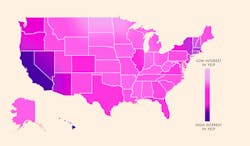
The most reliable way to judge is simple: perform searches in your own market. Type “dentist near me,” “cosmetic dentist [city],” and “Yelp dentist [city]” into Google. Note whether Yelp pages appear in the top results. For some regions (California, Hawaii, Massachusetts), Yelp consistently ranks and Google Trends suggests that you should strongly consider investing in your practice’s visibility on the platform. North Dakota ranks dead last in searches for “Yelp” on Google according to Google Trends. So, if you practice in Fargo, Yelp is not the hill to die on. If you practice in San Francisco, ignore Yelp at your peril.
Yelp is alive and well
The AI shake-up of search for dentists means that you may be scrambling to find other ways to attract new patients to your website and dental office. For offices with a decent Yelp reputation and in states where it matters, Yelp Ads offer a unique form of marketing insurance. Yelp’s own data indicates that advertisers receive a higher median number of leads than nonadvertisers.10 While self-reported platform stats should always be scrutinized, they align with a consistent theme: Yelp users often contact businesses quickly, sometimes within a day of discovery.
If you’re still skeptical about Yelp, I don’t blame you. But Google AI Overviews and “zero-click” search are siphoning away organic traffic from dental offices across the country, and there is no sign that this trend is going to reverse. My first recommendation is still to consider Google Ads to solve this problem, but our advertising dashboard, ProView Analytics, shows that many of our dental offices are generating more patient leads for less on Yelp Ads than they are from Google Ads. They also seem to book appointments at a higher rate. Based on the criteria above, you may want to earmark some of your marketing budget for Yelp Ads next year.
Editor's note: This article appeared in the November/December 2025 print edition of Dental Economics magazine. Dentists in North America are eligible for a complimentary print subscription. Sign up here.
References
- Garanko J. Semrush AI overviews study: what 2025 SEO data tells us about Google’s search shift. Semrush. July 22, 2025. Accessed September 24, 2025. https://www.semrush.com/blog/semrush-ai-overviews-study
- Semrush. Navigational query analysis within AI Overviews. March 2025. Accessed September 24, 2025. https://www.semrush.com/blog/semrush-ai-overviews-study
- Savage M. AI summaries causing ‘devastating’ drop in audiences, online news media told. The Guardian. July 24, 2025. Accessed September 24, 2025. https://www.theguardian.com/technology/2025/jul/24/ai-summaries-causing-devastating-drop-in-online-news-audiences-study-finds
- Goodwin D. Google’s AI Overviews are hurting clicks: Pew study. Search Engine Land. July 24, 2025. Accessed September 24, 2025. https://searchengineland.com/google-ai-overviews-hurting-clicks-study-459434
- Adegbola A. Yelp unveils AI features to streamline local business discovery. Search Engine Land. December 10, 2024. Accessed September 24, 2025. https://searchengineland.com/yelp-ai-features-local-business-discovery-449079
- Fast Facts. Yelp. June 30, 2025. Accessed September 29, 2025. https://www.yelp-press.com/company/fast-facts/default.aspx
- Amos R, Maio R, Mittal P. Reviews in motion: a large scale, longitudinal study of review recommendations on Yelp. arXiv. Cornell University. February 18, 2022. Accessed September 29, 2025. https://arxiv.org/abs/2202.09005
- 50+ compelling local SEO stats (and how to make them work for you). Synup. Accessed September 24, 2025. https://www.synup.com/en/local-seo-statistics
- Largest local SERP study spanning 49 local business categories. Synup. 2024. Accessed September 29, 2025. https://www.synup.com/en/what-is-ranking
- Yelp for Business. Drive more leads. Advertise your business on Yelp. Accessed September 29, 2025. https://business.yelp.com/products/yelp-ads
About the Author
 Jonathan Fashbaugh
Jonathan Fashbaugh
Jonathan Fashbaugh is the president of Pro Impressions Marketing. He advises dental offices nationwide on SEO, advertising, and patient acquisition. He is the author of The Marketing Mix That Works: A Comprehensive Marketing Manual Designed to Help Dental Offices Grow, coauthor of The TMJ Trifecta: Solving Your Pain Puzzle, and is a frequent contributor to dental industry publications, including Dental Economics.