The transition valuation nobody talks about—until it’s too late
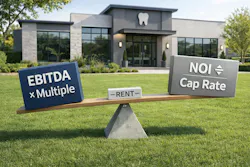
Everyone is talking about EBITDA multiples right now. And for good reason. When a dentist prepares to sell a practice, the multiple applied to earnings is the number that drives the headline value. It's what gets discussed with brokers, shared in DSO conversations, and benchmarked against what the doctor down the street got last year.
But there's a second number in most transactions—one that rarely gets the same attention—that can swing the outcome by six figures. That number is the real estate. Here's what most dentists don't realize until they're already in a transaction: in many practice sales—especially those involving DSOs—the buyer has no intention of purchasing the real estate. The building gets evaluated separately by a different buyer pool, using entirely different metrics. That means every practice sale involving real estate is two valuations happening in parallel. One is getting all the attention. The other is often being left to chance.
"Every practice sale involving real estate is two valuations happening in parallel. One is getting all the attention. The other is often being left to chance."
Two valuations. Two methodologies.
When a practice sale closes, two valuations have taken place—even if they were never discussed in the same conversation.
The practice is valued on EBITDA: earnings before interest, taxes, depreciation, and amortization. A buyer—a DSO, a private equity-backed group, or an individual dentist—applies a market multiple to that number. This is the conversation brokers lead with. It's the number most dentists have in their heads when they think about what their practice is worth.
The real estate, if the seller owns it, is valued on a completely different framework: net operating income, or NOI, divided by a capitalization rate. This calculation doesn't happen in the same room as the EBITDA conversation. It happens with a different buyer—typically a real estate investor or a sale-leaseback partner—evaluating the property on its own income merits.
One buyer is evaluating EBITDA and applying a multiple. A different buyer is evaluating NOI and applying a cap rate. These two buyers are not aiming for the same outcome. And the decisions that look optimal for one don't always translate cleanly to the other.
That misalignment is where value gets lost.
How real estate value actually works
For owner-occupied dental real estate, the valuation process starts with NOI—the income the property generates after operating expenses, before debt service. In a dental context, this is typically the rent the practice pays to the building, even if you're paying yourself as landlord, minus property-level operating costs.
The cap rate—short for capitalization rate—is then applied to that NOI to arrive at the property's value. The formula is straightforward:
Property value = NOI ÷ cap rate
Here's what that looks like with real numbers. Say your property generates $80,000 in annual NOI. At an 8% cap rate:
$80,000 ÷ 0.08 = $1,000,000
That's a million-dollar asset. Now watch what happens with a 50-basis-point shift in either direction—the kind of movement that's well within normal market range:
7.5% cap rate: $1,066,667 (+$66,667)
8.5% cap rate: $941,176 (-$58,824)
That's a $125,000 swing from the same NOI—and you haven't changed a single thing about the practice itself.
"A 50-basis-point shift in cap rate on $80,000 NOI creates a $125,000 swing in real estate value. That happens without touching the practice at all."
Where the two valuations collide
Here's where it gets consequential.
The rent your practice pays is the bridge between both calculations—and it's pulling in two directions at once.
On the practice side: rent is an operating expense. Higher rent compresses EBITDA. Lower rent expands it. A change of $2,000 per month is $24,000 per year—and when you apply a market multiple, even a conservative one, that's a meaningful shift in practice value.
On the real estate side, rent is revenue to the property. It flows into NOI, which means the same rent decision that reduces your EBITDA also reduces the income basis that the property is valued on.
This isn't a small nuance. A $24,000 annual rent adjustment, applied through both lenses, can move the combined transaction value by far more than that number suggests in isolation. The multiple on the practice side amplifies it. The cap rate division on the real estate side amplifies it again. The two calculations don't cancel each other out—they compound.
Most lease arrangements in dentist-owned practices are set informally based on what seemed reasonable years ago, or what an accountant suggested for tax purposes. Very few are structured with both buyer pools in mind. That's not a criticism; it's simply not information most dentists encounter until they're already in a transaction.
That’s exactly the problem. If you haven’t planned both valuations, the second one will be determined for you—usually late in the process, by buyers who are underwriting the deal on their own timeline and with their own assumptions.
Where the data gap shows up
Here’s where this becomes a real risk—and it’s not a question of appraiser quality. It’s a data problem.
When an appraiser evaluates a dental or medical building, they rely on the best published benchmarks available to them—typically cap rate surveys from major institutional real estate firms. Those surveys are industry standard, widely publicized; they just weren’t built for a private dental practice. They were built to cover large medical office buildings and national NNN retail properties, not a 4,000 SF owner-occupied dental building with a personal guarantee and a single-practice tenant.
Nobody had built a cap rate report specifically for this property type. Until now. Without one, evaluations default to the nearest available data—and that data reflects a different risk profile, a different buyer pool, and a different lending environment than the one that actually governs small dental and medical buildings.
The result is that a rent figure can be established through a process that satisfies a lender and appears well-supported on paper—but doesn’t translate into a defensible NOI when an investment buyer applies the cap rate that governs this asset class. Investors won’t anchor to the comparable lease opinion; they’ll anchor to their return requirements.
A building that appears to be worth $1.2 million based on that rent structure may only attract offers in the $900,000 to $1 million range when evaluated by investors applying a market cap rate to actual NOI. That gap isn’t theoretical. It’s how investment real estate is priced.
It’s not uncommon for that difference to show up as a $200,000–$300,000 gap between what a seller expected and what the investor market will actually pay.
And it’s not something that can be easily fixed once the lease is in place.
In many cases, the only way to reset that value is through time—letting the lease term run out and reposition the rent at market. Depending on the lease structure, that can take five, seven, sometimes 10 years—or the entire initial lease term. Until then, the value is what the NOI supports, not what the original evaluation suggested.
Nobody in that room had the wrong intentions. They just didn’t have the right data.
Timing is everything
There's another issue that doesn't get enough attention: when rent adjustments happen.
Late-stage changes—made after a letter of intent is signed, or when a buyer is already underwriting the deal—are almost always disadvantageous to the seller. Buyers are doing their own math. They've already modeled the real estate separately. If the lease looks below market, above market, or simply inconsistent with how the property is being valued, they'll price in the uncertainty or renegotiate from a position of strength.
This is especially relevant in DSO transactions, where the acquiring group has real estate teams that scrutinize lease terms in detail. They're looking at lease length, renewal options, rent escalation clauses, and whether the stated rent reflects what the market would actually support. A lease that hasn't been reviewed in years may look very different to a sophisticated buyer's underwriting team than it does to the selling dentist.
The sellers who protect the most value on the real estate side are the ones who address lease structure before they're in a transaction, not to inflate anything artificially, but to ensure the numbers are coherent and defensible when both calculations are reviewed side by side, as they will be.
What this means in practice
You don't need to become a commercial real estate expert. But if you own your building and you're thinking about a practice transition in the next three to seven years, there are a few things worth reviewing now:
First, understand what your property is actually worth under current conditions—not just what you paid for it. The market has shifted considerably, and cap rates in medical/dental real estate vary significantly by market.
Second, make sure your lease reflects that reality. The rent structure should make sense whether you're looking at it as a practice expense or as property income. If there's a disconnect, it's worth addressing now.
Third, don't let the EBITDA conversation crowd out the real estate conversation. They're separate calculations. They're both significant, and both deserve attention when you're planning an exit.
The bottom line
Every practice sale involving real estate involves two valuations and, often, two separate buyer conversations. EBITDA drives one; NOI and cap rate drive the other. Neither cancels out the other—they're measuring fundamentally different things—but both feed into what you ultimately walk away with.
The dentists who protect the most value are the ones who understood both frameworks before they were in a transaction—and made decisions that worked with each buyer's logic rather than against one of them.
The industry has built an entire infrastructure around helping dentists optimize the EBITDA side of the equation. Brokers, consultants, and advisors have that conversation every day. The real estate side is different. It’s less visible, less discussed, and in most cases, not actively managed as part of the transition strategy.
That’s not a gap that closes itself. It closes when you start asking the right questions—ideally years before anyone else is asking them for you.
And when it’s ignored, it doesn’t disappear—it just shows up later in the form of a lower offer.
What you decide to do with the real estate after the practice sale—whether you monetize it immediately or hold it as a long-term income asset—is where the financial modeling begins to build considerable retirement value. For a lot of dentists, that building is the most significant asset they’ll ever own. How it gets structured, leased, and eventually transferred or sold shapes financial outcomes for decades. That conversation deserves its own strategy—separate from, but connected to, everything discussed here.
About the Author
Jason Price
Jason Price is the founder of NextSite Consulting, a firm that helps dental practice owners navigate real estate decisions—including lease strategy, property valuation, and how real estate fits into a broader exit plan. Learn more at nextsiteconsulting.com.