November/December 2025 Pearls for Your Practice
What you'll learn in this article
- How Exocad Elite Level 1—The Drip—bridges the final gap in digital dentistry, giving clinicians hands-on design control for faster, more precise workflows
- How Ultradent Ease-In-Shields simplify diode laser procedures by integrating laser-safe protection directly into your loupes for comfort and efficiency
- How the Carestream CS 9600 CBCT elevates imaging accuracy, safety, and workflow integration through AI-guided positioning and advanced 3D versatility

Exocad Elite Level 1—The Drip
We’ve been inching toward a fully digital workflow in our practice for a while now. We scan everything. We 3D print a bunch. We’ve got the toys. But there’s been one big missing link that’s kept us from going 100% digital: the design piece—that crucial step where all the digital tools actually come together into a treatment plan that makes sense, looks great, and is ready to print or mill. For that, we’ve always had to rely on someone else—a lab, a designer, a service. And honestly, it’s been fine ... but it hasn’t been ours.
Then, this past January, I saw Dr. Diana Tadros speak at the Seattle Study Club Symposium. She talked about her Exocad course—The Drip—and within a few minutes, I knew this was exactly what we were missing. She wasn’t just showing screenshots or buzzwords. She was walking through real-life workflows, explaining how Exocad can be used not just by full-time lab techs, but by dentists and team members in everyday practices. I left that talk and immediately signed my wife up for the course.
She went a couple of months ago, and what she’s brought back into the practice has been game-changing, like actual difference-in-the-day-to-day stuff. We’re now hopping into Exocad to design single-tooth mockups for patients in real time. We’re using it to do wax-ups for bigger comprehensive cases—cases we used to outsource and then cross our fingers hoping the turnaround and communication would work out. We’re using it to plan transitional prosthetics, Maryland bridges, and those weird little flipper situations that come up more than we’d like to admit. The turnaround is quicker, the results are better, and it just feels good to have that control.
Dr. Tadros’s course—officially called the Exocad Elite Level 1 Course: The Drip—is built for practices like ours. You don’t need to be a tech wizard walking in. The course is hands-on, laptop-based, and grounded in real-world dentistry. You’re not just learning how to click buttons—you’re learning how to use design software in a clinical, meaningful way. The two-day experience includes everything from single-tooth design to complex wax-ups to 3D printing integration. It’s not just useful for full rehabs ... it’s useful on Tuesday morning at 10:30 when your patient just broke no. 9.
If your practice is already scanning and printing, but you still have to phone a friend for the design, this is the missing link. It gives you speed, control, and precision—and that can have a huge impact across everything from case acceptance to final fit.
I’m glad I stumbled into that lecture last January. And I’m even more glad I hit “register” as soon as I got back. My wife’s loving the new skills, our patients are benefiting, and our whole workflow is finally starting to feel complete.
Triple off the wall for Dr. Diana Tadros and Exocad Elite.
Ease-In-Shields
I’ve been thinking lately about how the things that really slow you down in life aren’t always the big, obvious obstacles. It’s not the giant boulder in the road—it’s the tiny pebble in your shoe. You can walk around the boulder. You can’t walk five feet with that pebble digging into your heel.
Dental practice life is the same way. It’s not the crown redo or the late patient that throws off your whole rhythm—it’s the 10 little annoyances that chip away at your day. One of those pebbles? Having to take off your loupes and headlight just to put on laser safety glasses for a 30-second diode treatment and then reverse the whole dance to finish the procedure. It doesn’t seem like it should be that big of a deal, but do it 10 times in a day and you’ll be ready to throw something across the operatory.
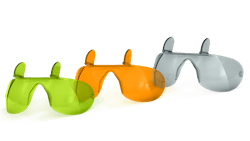
That’s where the Ultradent Ease-In-Shields come in. They’re like those days when your sock actually stays up, your bur doesn’t fly across the room, and no one asks if you “take their insurance.” It’s just one less pebble in your shoe.
These things are super thin, laser-safe inserts that drop right into your existing loupes—behind the lenses, not in front—so there’s no weird distortion or extra bulk. They don’t fog up. They don’t throw off your depth perception. You don’t have to adjust your light or retighten your head strap every time you switch tasks. You just leave them in, and they are there when you need them.
The shields are made of a lightweight polycarbonate that meets the ANSI Z136.1 safety standard for laser use, so you can use them with your diode laser procedures without needing an extra pair of safety glasses. And because they’re designed to work with most major loupe brands, you’re not stuck creating some Frankenstein setup just to meet basic safety requirements and protect your eyes.
What I like most, though, is that these were clearly designed by someone who’s actually done dentistry. There’s no overengineering here. No Bluetooth, no app, no charger. They just do the thing they’re supposed to do—protect your eyes from laser light—without getting in the way of everything else you’re doing.
It’s a simple fix to a real problem. And that’s the kind of product I’ll always make room for in my op. It might not be the most exciting thing I’ve ever added to my workflow, but it’s made my days a little smoother. A little less frustrating. A little more pebble free.
Ultradent Ease-In-Shields: not a game-changer, just a day-improver. And honestly, I’ll take that every time. Double to the right field corner for Ease-In-Shields!
Carestream CS 9600 CBCT
The other day, I was cleaning out the storage closet in our office and found one of those old digital cameras from college. Not a nice DSLR; I’m talking about the kind that ran on AA batteries, had a tiny LCD screen, and could store about 12 photos if you were lucky. It was peak early 2000s tech. I remember thinking it was the coolest thing in the world back then.
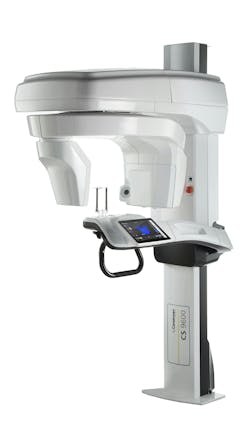
Fast forward to now, and I have a phone in my pocket that can shoot 4K video, edit it, and post it to social media before I even finish my coffee. It’s wild how far technology has come, and that includes dental imaging. I used to think panoramic films were fancy. Now, we’ve got the Carestream CS 9600, and it’s like trading in a flip phone for a spaceship.
The CS 9600 is one of those pieces of equipment that can quietly change your practice. At first glance, you just think, “Oh, cool, a 3D CBCT imaging system.” But once you start using it, you realize it’s a lot more than that. The image quality is incredibly crisp and detailed, and it gives you flexibility with everything from endo to implants to airway analysis. You get CBCT, 3D facial scanning, panoramic, ceph, and even bitewings.
What really stands out to me, though, is how smart the system is. The CS 9600 uses artificial intelligence to help guide patient positioning and make sure you’re capturing the right area every time. It automatically adjusts for common user errors and even includes a built-in video positioning guide on the unit, so your team doesn’t need to guess or fumble their way through the setup. This kind of consistency makes a big difference, especially in a busy office with multiple team members using the system.
Another big win is patient comfort and safety. The system is designed to minimize radiation exposure while still delivering high-resolution images. Plus, the open design helps with patients who are anxious or claustrophobic. I’ve had more than one patient say, “Oh wow, that wasn’t bad at all,” which isn’t something we hear very often in dentistry.
On the back end, the software is intuitive and clean. I don’t need a weekend course or a 60-page manual to figure it out. The imaging integrates well with our other PMS and imaging systems, and the data is easy to access and share. Whether I’m planning a surgical guide or showing a patient their airway, the CS 9600 helps me communicate clearly and confidently.
I know it’s not the most glamorous thing in the world to write about imaging technology, but this one actually gets me a little fired up. It’s not just about pretty pictures—it’s about efficiency, accuracy, and making our daily workflow smoother. It’s about getting out of the darkroom days and stepping into something that helps us practice better.
So, yeah, I might still have my old Better Than Ezra and Oasis CDs somewhere in that same closet, and I’ll always have a soft spot for simpler times. But when it comes to imaging in 2025, I’ll take the spaceship over the film any day. Solo homer to centerfield for Carestream!
Editor's note: This article appeared in the November/December 2025 print edition of Dental Economics magazine. Dentists in North America are eligible for a complimentary print subscription. Sign up here.
About the Author
 Joshua Austin, DDS, MAGD
Joshua Austin, DDS, MAGD
Joshua Austin, DDS, MAGD, is a graduate and former faculty member of the University of Texas Health Science Center at San Antonio School of Dentistry. Author of Dental Economics’ Pearls for Your Practice column, Dr. Austin lectures nationally on products, dental technology, online reputation management, and social media. He maintains a full-time restorative dentistry private practice in San Antonio, Texas. You may contact Dr. Austin at [email protected].
Updated June 21, 2023