More evidence for buffered anesthetic
Key Highlights
- A randomized clinical trial found that buffered articaine produced significantly less injection pain, eliminated burning sensations, and achieved pulpal anesthesia twice as fast as nonbuffered articaine.
- Buffering local anesthetics with sodium bicarbonate raises the pH, increasing the amount of active anesthetic available and reducing the discomfort associated with acidic injections.
- Faster, more comfortable anesthesia can improve patient experience, practice efficiency, and patient perception of care, making buffered anesthetics an increasingly attractive option for dental practices.
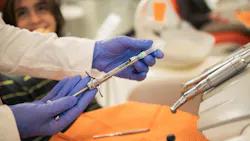
Buffered articaine works faster and the injection is less painful than nonbuffered articaine, according to a clinical study published in Endodontology in April of 2026 by Patankar et al.1 This new original research adds to an already large body of evidence in favor of buffered local anesthetic and is relevant to both the clinical and the economic perspectives of patient care. The study was a double--blind, randomized controlled trial involving 40 patients with symptomatic irreversible pulpitis in maxillary first molars. Twenty patients received conventional non--buffered 4% articaine with epinephrine 1:100,000, and 20 received buffered versions of the same drug. Compared with the nonbuffered group, the buffered group reported significantly less pain during deposition (P < 0.0001), faster pulpal anesthesia onset (P = 0.0001), and no burning sensation, which was observed in the nonbuffered group (P = 0.001).
Digging deeper into the study’s results, pain during needle insertion was essentially the same in both groups, but pain during solution deposition was dramatically different. Median pain during deposition was rated as 4/10 in the nonbuffered group and 0/10 in the buffered group. Burning sensation was reported in 45% of the nonbuffered group and in 0% of the buffered group. Onset of pulpal anesthesia was twice as fast in the buffered group: 60 seconds versus 30 seconds. Both groups ultimately achieved pulpal anesthesia, and the need for supplemental anesthesia was the same.
The science of buffering
Why does buffering produce such a marked reduction in injection pain and faster onset of anesthesia? Local anesthetics containing epinephrine must be formulated in an acidic solution to ensure adequate shelf--life and, upon injection, typically enter tissue at a pH of approximately 3.5.2 At this low pH, the drug exists almost entirely in its pharmacologically inactive ionized form (lipophobic), with virtually none present in the active deionized form (lipophilic).3 Onset of local anesthetic action is delayed as the body slowly neutralizes the acid and shifts enough anesthetic molecules into their active deionized form. It is believed that the acidic nature of local anesthetic solutions also contributes to the pain experienced by patients during injection.3,4
Buffering the solution with sodium bicarbonate prior to injection neutralizes the acidity, helping to reduce injection pain and onset latency, and may improve overall anesthetic efficacy.5 These effects can be more profound in patients with inflamed tissue such as pulpally involved teeth, where anesthesia is much less predictable and patient anxiety is commonly higher.3
The shot matters
Fair or not, patients can only assess your practice based on things they can observe.
- Was the staff kind and professional?
- Were you on time?
- Was there any pain involved?
That final question represents a well--recognized obstacle for many patients. In a landmark study, Milgrom and colleagues found that more than 25% of surveyed adults reported clinically significant fear of injections, and approximately 1 in 20 respondents reported avoiding, canceling, or failing to attend dental appointments because of injection--related anxiety.6 These findings suggest that fear of dental injections is a significant barrier to accessing dental care for a substantial segment of the population.7
Dentists have long employed a variety of strategies to reduce pain from injections, including topical anesthetics, distraction techniques, warming the anesthetic solution, and other adjunctive measures.8 And while every clinician is seeking to deliver a painless local anesthetic injection, patients often tolerate some degree of pain. The recent study by Patankar and colleagues therefore delivers encouraging news: buffered anesthetics can reduce injection pain and meaningfully enhance patient comfort.1
Your best shot
The practice--building insight is straightforward: a better local anesthetic injection experience is not just a clinical win; it’s an efficiency win, a profitability win, and a long--term brand win.
The use of buffered anesthetics is becoming the new standard of care for local anesthetic injections. As patients become more aware of this option, they are increasingly likely to request it, making it advantageous for clinicians to proactively integrate buffering into routine practice when that demand arises.
Two dental companies currently offer convenient devices for buffering standard local anesthetic cartridges, and a third company is expected to introduce a prebuffered cartridge soon. Select the option that best fits your needs and transition to buffered anesthetics — it will benefit your practice and your patients!
Editor's note: This article appeared in the July/August 2026 print edition of Dental Economics magazine. Dentists in North America are eligible for a complimentary print subscription. Sign up here.
References
- Patankar VR, Jain AK, Rao RD, Langade D. Pain perception and anesthetic efficacy of buffered articaine in maxillary molar buccal infiltration: a randomized controlled trial. Endodontology. 2026;38(2):130-138. doi:4103/endo.endo_211_25
- Goodchild JH, Donaldson M. Comparing the pH change of local anesthetic solutions using two chairside buffering techniques. Compend Contin Educ Dent. 2016;37(5):e6-e12.
- Kattan S, Lee SM, Hersh EV, Karabucak B. Do buffered local anesthetics provide more successful anesthesia than nonbuffered solutions in patients with pulpally involved teeth requiring dental therapy? A systematic review. J Am Dent Assoc. 2019;150(3):165-177. doi:10.1016/j.adaj.2018.11.007
- Malamed SF, Tavana S, Falkel M. Faster onset and more comfortable injection with alkalinized 2% lidocaine with epinephrine 1:100,000. Compend Contin Educ Dent. 2013;34(Spec No 1):10-20.
- Goodchild JH, Donaldson M. Three key reasons to add local anesthetic buffering to your clinical practice. Gen Dent. 2025;73(1):10-13.
- Milgrom P, Coldwell SE, Getz T, Weinstein P, Ramsay DS. Four dimensions of fear of dental injections. J Am Dent Assoc. 1997;128(6):756-766. doi:10.14219/jada.archive.1997.0301
- Heaton LJ, Leroux BG, Ruff PA, Coldwell SE. Computerized dental injection fear treatment: a randomized clinical trial. J Dent Res. 2013;92(7 Suppl):37S-42S. doi:10.1177/0022034513484330
- Meit SS, Yasek V, Shannon CK, Hickman D, Williams D. Techniques for reducing anesthetic injection pain: an interdisciplinary survey of knowledge and application. J Am Dent Assoc. 2004;135(9):1243-1250. doi:10.14219/jada.archive.2004.0399
About the Author
Jason H. Goodchild, DMD
Jason H. Goodchild, DMD, received his dental training at the University of Pennsylvania School of Dental Medicine in Philadelphia, Pennsylvania. He is currently director of scientific affairs at Colgate Oral Pharmaceuticals in New York, New York. He holds faculty appointments at Creighton University School of Dentistry (Omaha, Nebraska) and the Rutgers School of Dental Medicine (Newark, New Jersey).