What to use for anterior crowns
Key Highlights
- Porcelain-fused-to-metal crowns are rapidly disappearing from dentistry, driven largely by the efficiency and lower fabrication costs of ceramic alternatives such as zirconia and lithium disilicate.
- Lithium disilicate remains the preferred choice for many dentists for anterior single crowns due to its exceptional esthetics, reliable bonding, and strong long-term clinical performance.
- Esthetic zirconia is gaining popularity for anterior restorations by offering improved translucency and appearance, while full-strength 3Y zirconia remains a strong option for bruxing patients and high-stress cases.
Each month, Dr. Gordon Christensen answers a question from readers about everyday dentistry.
Q: I have used porcelain-fused-to-metal (PFM) crowns with great success for many years. But I am frustrated that my lab is encouraging me to change to another type of crown. Are these newer crown types better? Why are we moving away from PFM? What are my choices for anterior crowns, and which types are best?
A: Over the past several years, PFM crowns have slowly gone from nearly 70% use to 5% use, according to Glidewell Laboratories. Currently, the major crown types are various formulations of zirconia and lithium disilicate. Glidewell reports that over 90% of crowns are now ceramic. Although other crown types are available, their use is minimal. What has caused this significant change?
Making a zirconia crown is a relatively simple and inexpensive laboratory procedure requiring minimal time. Making a PFM, gold alloy, or lithium disilicate crown requires more laboratory time and is much more expensive. Dental laboratories prefer to produce the easily computer designed and milled zirconia crowns which dominate all other ceramic crowns.
As new laboratory technicians begin their careers, the emphasis is on the newer crown forms, with most new techs not learning how to fabricate PFM crowns.
PFM and gold alloy crowns are nearly extinct and soon will not be available except from older technicians.
Their demise does not indicate their clinical inadequacy. In some ways they are superior to the newer crowns. The popularity of the new crowns is primarily because they are easier and less expensive to fabricate and require less or no human involvement.
The following information provides some suggestions based on research and clinical empirical experience relative to what crown type would currently be best for anterior teeth.
Comparison of crown strength to enamel
Human enamel strength is about 100 MPa. Crown materials have far greater strength than enamel, with zirconia up to 1,000 MPa and lithium disilicate about 360 MPa. Why do crown materials need this much more strength than enamel? The dental cements currently used do not have a long-term bond to dentin that simulates the bond strength of enamel to dentin. This is an important issue when considering the type of crown to use in specific anterior crown clinical situations.
Current crown types to consider for anterior teeth
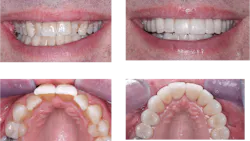
Lithium disilicate (figure 1)
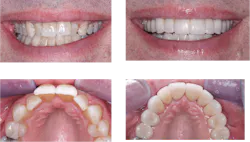
This material has proven itself over 12 years of clinical service to be one of the most esthetic and strongest single--crown materials in the history of dentistry. It has been my observation while providing many large attendance courses for dentists that currently most dentists would prefer this type of crown for their own anterior teeth. Should it be used for fixed prostheses? Ivoclar, the major producer of lithium disilicate crowns, suggests some anterior fixed prostheses can be adequately strong enough with IPS e.max if all aspects of the crown are at least 1 mm thick.
Clinicians Report Foundation has had lithium disilicate molar crowns in an in-vivo study including over 100 practicing dentists and numerous labs.
What to expect from well-fabricated lithium disilicate anterior crowns (based on CR Foundation in-vivo research):
- Excellent esthetics. Color match and translucency can be nearly perfect.
- Biocompatibility
- Low wear of opposing teeth after the stain and glaze have worn off the occlusal contacts
- Low breakage. CR Research has shown 6% breakage of single molar crowns at six to seven years in the mouth. Anterior crowns should show less breakage because of less force on the anterior teeth.
- Crowns do not come off in service because of hydrofluoric acid etch of the crown intaglio surfaces, phosphoric acid etch of the tooth prep surface, and usually resin cement impregnated into the acid-etched irregularities on both the crown internal surfaces and the tooth prep surfaces. If the patient has high caries potential, cariostatic resin-modified glass ionomer cement can be used if all aspects of the crown surfaces are at least 1 mm thick.
- Superior patient acceptance
- Lithium disilicate crowns are being used less over the last few years because of the growth of the following types of crowns.
- Currently, this is still the most dentist-accepted anterior crown type.
Zirconia (full-strength, 3Y—3 mol% yttria (yttrium oxide) (figure 2)
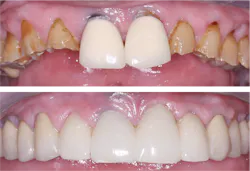
What to expect from well-fabricated 3Y zirconia crowns (based on CR Foundation in-vivo research):
- Significantly more opacity than lithium disilicate
- Difficult to match colors without superficial staining or using internal staining at the presintered zirconia stage
- Can be as thin as 0.6 mm thick without breaking in service
- Low wear of opposing teeth after external stain and glaze have worn off
- Optimum use for bruxing patients
- Significant percentage of crowns come off in service and require recementation
- Optimum “healing” of small cracks (transformational toughening)
- If internally stained or with properly applied superficial stains, this type can be used with success.
Limitations
- Opaque appearance without superficial layer of glaze and stain or the lesser used, more time-consuming internal staining is used
- May wear opposing teeth if poorly finished and polished
- More difficult to adjust after fabrication
- Less ideal for high-esthetic-need anterior crowns
Zirconia (“Esthetic Zirconia,” 4, 5, and higher molar percent yttria)
What to expect from well-fabricated 4, 5, and higher yttria content zirconia crowns (based on CR Foundation in-vivo research):
When more yttria is added, the material has the following characteristics:
- Lower strength than 3Y
- Reduced or absent transformational toughening; “healing” of small cracks
- Some wear of opposing teeth more than 3Y
- Improved esthetics when compared to 3Y
- Use of this type of zirconia is growing rapidly.
Other ceramic crowns
A small percentage of other crowns are available such as yttria-based ceramic crowns, but these are used infrequently. Zirconia in its numerous forms and lithium disilicate are the most dominant.
Summary
Currently, lithium disilicate (IPS e.max) is still the most preferred anterior single crown by dentists, but “esthetic” zirconia—4Y yttria and higher—is now growing in use and appears to be the future.
Internal staining of 3Y zirconia is available for improved strength and has very good to excellent esthetics, but it is not available from some labs.
Ceramic anterior crowns can be excellent, but numerous improvements are still awaiting long-term research.
Editor's note: This article appeared in the July/August 2026 print edition of Dental Economics magazine. Dentists in North America are eligible for a complimentary print subscription. Sign up here.
About the Author
 Gordon J. Christensen, DDS, PhD, MSD
Gordon J. Christensen, DDS, PhD, MSD
Gordon J. Christensen, DDS, PhD, MSD, is founder and CEO of Practical Clinical Courses and cofounder of Clinicians Report. His wife, Rella Christensen, PhD, is the cofounder. PCC is an international dental continuing education organization founded in 1981. Dr. Christensen is a practicing prosthodontist in Provo, Utah.