Why patients say "I'll think about it"
Key Highlights
- Why "I'll think about it" is almost always a communication signal, not a rejection, and what patients are really telling you.
- The psychological triggers behind patient hesitation - from fear to cost concerns - and why each one is a communication opportunity.
- Practical phrases and strategies your team can use right now to improve case acceptance without feeling pushy.

Picture this: You've just walked a patient through a thorough treatment plan. You showed them the X-rays, explained the long-term consequences of waiting. Your presentation was clear and well-intentioned. Then they give you that polite smile and say, "Thanks - I'll think about it."
And you never hear from them again.
It happens every day. For a lot of dental teams, it feels like a door quietly closing. But "I'll think about it" is rarely the end of the story. It's a signal - one your team has a real opportunity to respond to.
Understanding the psychology behind patient hesitation is the foundation of stronger dental case acceptance. And the reasons patients hesitate might not be what you think.
It's not personal—it's psychology
Patients don't reject treatment plans because they doubt your skills. They hesitate because of how the brain handles uncertainty and perceived risk.
Research in patient decision-making describes a three-part model of human judgment. The thinking brain wants data. The feeling brain wants to feel safe. And the survival instinct wants nothing to do with anything unfamiliar or overwhelming. A large treatment plan, an unknown procedure, and a four-figure number can all trigger that protective response.
When you present treatment, you're speaking to the thinking brain. But the decision to say yes or no comes from the other two. This is why a patient can follow your explanation perfectly and still walk out without committing. Dental communication strategies that work on all three levels consistently outperform presentations that rely on clinical facts alone.
Why patients really hesitate
Here are the five most common triggers behind "I'll think about it":
- Cost concerns. The number feels big with no clear path forward. Even if you mention payment options, many patients mentally check out once they hear the total.
- Fear and anxiety.Dental anxiety is common. Some patients agree in the chair just to escape the conversation, then avoid following through.
- Confusion about the diagnosis. Clinical language creates distance. If a patient doesn't understand why they need treatment, they won't feel urgency to act.
- Feeling overwhelmed. A multi-procedure plan with a large investment is a lot to absorb in one sitting. When people feel overwhelmed, their default is to stall.
- Lack of perceived urgency. If it doesn't hurt, patients assume they have time. Without a clear picture of what waiting costs them, delay feels safe.
None of these are patient problems. Every single one is a communication opportunity.
Hesitation is a communication issue, not a patient problem
When a patient hesitates, it usually means they didn't receive information in a way they could absorb and act on.
Three of the most common mistakes that undermine case acceptance are unclear communication, insufficient financial transparency, and inconsistent follow-up. Fixing just one can move the needle. Fixing all three is transformative.
Improving case acceptance starts with treating every treatment conversation as exactly that - a conversation, not a presentation.
Practical communication strategies that work
Simplify your language first
Jargon creates psychological distance. When a patient hears "periapical lesion" or "Class II composite restoration," their brain shifts into protection mode. They won't ask what it means because asking feels embarrassing, so they nod and leave without committing.
A structured, patient-friendly treatment plan presentation replaces clinical terminology with everyday language paired with clear visual and cost breakdowns. Try these swaps:
- "Decay reaching the nerve" instead of "pulpitis"
- "A tooth-colored filling" instead of "composite resin restoration"
- "Gum infection affecting the bone" instead of "advanced periodontal disease"
When patients understand what's happening in their mouth, they're far more likely to act.
Tell the story, not just the diagnosis
Move from "here's what's wrong" to "here's what happens next depending on your choice." Patients respond to their own future, not abstract clinical information.
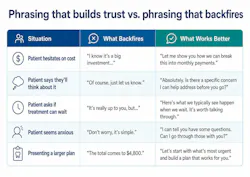
Try: "Right now this cavity is small - we can fix it with a simple filling today. If we wait six months, there's a good chance it reaches the nerve and you're looking at a root canal, which is a much larger investment."
This patient-centered framing also connects to how today's patients research decisions - especially those exploring cosmetic treatment, where understanding what's personally at stake often matters more than any clinical detail.
Address the emotion before the explanation
Before logic can land, people need to feel heard. If a patient looks uncertain, pause and ask: "I can tell you're taking all of this in. What's on your mind right now?"
Then listen. What comes out tells you the real objection - and gives you a chance to address it directly.
Reinforce value before discussing price
When cost comes up, anchor the conversation in value first. "Taking care of this now saves you money down the road. A filling today is a fraction of what a crown or root canal costs later." Then walk through payment options calmly. Many patients who say no to the total will say yes to a manageable monthly number.
Your reputation plays a role here too. The reviews patients read before walking in set the emotional tone for how open they'll be when treatment is presented. Strong dental reputation management and strong in-office communication work together.
Get your whole team involved
Case acceptance isn't just the dentist's job. When a patient hears consistent, value-based messaging from multiple people they trust throughout the appointment, it reinforces the recommendation. Hold a brief huddle each morning to flag patients with unaccepted treatment, and make sure every team member knows the payment options available.
Following up without feeling pushy
Many patients who say "I'll think about it" would say yes with a thoughtful follow-up. The challenge is most practices let those conversations go cold.
A warm check-in within 48 to 72 hours - "We just wanted to make sure you didn't have any questions after your visit" - communicates care rather than pressure and gives patients an easy opening to raise a concern they didn't voice in the chair.
Tools like Annie AI make consistent follow-up achievable without adding to your team's workload. Research on the real-world impact of dental AI shows that practices using thoughtful automated outreach often recover significant revenue from previously unaccepted treatment.
"I'll think about it" doesn't have to be the end of the conversation. When your team understands the psychology behind hesitation and responds with communication that addresses emotion alongside information, case acceptance improves - not because you're selling harder, but because patients feel genuinely supported. Pick one strategy from this article, practice it this week, and see what shifts.
FAQ
Q: Why do patients hesitate even when they understand their diagnosis? A: Understanding a diagnosis and feeling ready to act on it are two different things. Patients hesitate because of cost, fear, or overwhelm even when the clinical information makes sense. Addressing those emotional layers is often more effective than repeating the clinical case.
Q: How can I improve dental case acceptance without being pushy? A: Lead with listening. Ask open-ended questions, acknowledge concerns, and frame every conversation around the patient's long-term health. Patients respond to support, not pressure.
Q: What should I say when a patient wants to talk to their spouse first? A: Respect it and make follow-up easy. Offer a written summary to take home and ask when it would be convenient to answer questions together. A call within 48 hours keeps the conversation alive without pressure.
Q: How does dental anxiety affect case acceptance? A: Anxious patients often agree in the chair just to end the conversation, then avoid following through. Acknowledging anxiety directly and giving patients space to share their concerns can significantly improve both trust and commitment.
Q: When is the right time to discuss the financial side of a treatment plan? A: After the patient understands the clinical need and the value of treatment - never before. Once they clearly see why treatment matters personally, the financial conversation becomes much easier.
About the Author
Danielle Caplain
Danielle Caplain is a copywriter at My Social Practice, where she crafts compelling, SEO-friendly content that helps dental practices grow their online presence and connect with patients. My Social Practice is a dental marketing company that provides comprehensive dental marketing services to thousands of practices across the United States and Canada.