The “Let Them/Let Me” leadership model: A practical framework for reducing stress and improving communication in dental practices
Key Highlights
- Reframe leadership chairside: The “Let Them/Let Me” model reduces burnout by shifting focus from controlling patients and staff to mastering personal emotional responses.
- Regulate first, act second: Practical tools like PAUSE and the ABCDEF loop convert emotional reactivity into strategic, values-based leadership decisions.
- Improve outcomes through clarity: By observing patterns, addressing systems—not personalities—and modeling self-regulation, practices see stronger case acceptance, team engagement, and operational stability.

Leadership begins chairside
Leadership challenges in dentistry rarely announce themselves as “leadership problems.” Instead, they appear chairside: anxious patients decline treatment, hygienists disengage under overload, and front-desk handoffs break down during peak pressure. Dentists are expected to deliver precise clinical care while simultaneously managing the emotions of patients, staff, and themselves. This cognitive and emotional load is unsustainable and can lead to burnout.1
Current leadership models in dentistry frequently emphasize scripts, incentives, or behavioral compliance. While useful, these approaches often fail to address the emotional labor underlying interpersonal conflict. The “Let Them/Let Me” model offers immediate relief by reframing leadership effort; rather than attempting to control other people’s reactions (Let Them), it redirects energy toward mastering one’s own responses (Let Me).
Defining the “Let Them” principle
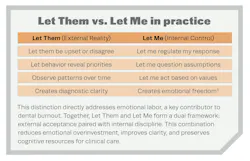
Let Them, popularized by Mel Robbins,2 is a psychological and behavioral principle that emphasizes noninterference with other people’s emotions, reactions, and choices while maintaining responsibility for one’s own responses. At its core, Let Them means allowing others to express disagreement, hesitation, frustration, or emotion without immediate correction or escalation. The principle recognizes a fundamental reality: clinicians do not control the internal states or behaviors of patients or staff.
Let Them means:
- Let them be upset.
- Let them disagree.
- Let them react emotionally.
- Let them speak freely.
- Let them behave as they choose.
Importantly, Let Them does not imply agreement, approval, or passivity. It simply acknowledges a fundamental reality: we do not control other people’s internal states or external behaviors.
In dental settings or practice, Let Them may involve the following:
- Let patients express periodontal hesitations without immediate correction.
- Let team members demonstrate priorities through consistent behavior rather than promises.
- Let repeated patterns—not isolated moments—inform decisions about trust, roles, and care planning.
Defining the “Let Me” principle
Let Me is the internal counterpart to Let Them. While Let Them governs external reality or autonomy, Let Me affirms personal responsibility for one’s own thoughts, emotions, reactions, and decisions. This distinction restores agency by shifting attention away from controlling others and back toward self-leadership. Let Me involves regulating emotional responses, pausing before reacting, questioning assumptions, and choosing actions aligned with professional values rather than impulse. It is not self-blame, emotional suppression, or tolerance of mistreatment. Instead, Let Me supports intentional, values-based leadership.
At its core, Let Me means:
- Let me regulate my emotions.
- Let me pause before reacting.
- Let me question my assumptions.
- Let me choose my response.
- Let me decide what action, if any, is required.
What Let Me is
- Ownership of one’s internal experience
- Emotional regulation
- Intentional, values-based responses
What Let Me is not
- Self-blame
- Emotional suppression
- Enduring mistreatment without boundaries
- Ignoring problems that require action
Let Me is about agency, not self-criticism. It shifts leadership from external control to self-leadership.
Self-regulation before leadership action: PAUSE
Emotional intelligence begins with self-mastery.⁴ Before applying Let Them externally, dentists must internalize Let Me through deliberate self-regulation. The PAUSE model (adapted from Nguyen5) provides a practical method. The PAUSE framework provides a structured method for interrupting emotional reactivity.
P—Pause: Interrupt the stress response before cortisol drives decisions. Even a brief pause prevents reactive emails, chairside tension, or impulsive personnel actions.
A—Ask: “Does this thought serve me, my team, or this patient right now?”
U—Understand: Thoughts are interpretations, not facts. “She’s late again” becomes “She’s late again—there may be contributing factors.”
S—Say the mantra: “Continuing this thinking increases my suffering without improving outcomes.”
E—Evaluate: Choose the next professional action deliberately: inquiry, data collection, or strategic intervention.
Practice example: A front-desk insurance delay initially triggers irritation. PAUSE reveals the true issue—untrained temporary coverage during maternity leave. Cross-training resolves the problem, and collections improve the following month. PAUSE converts emotional hijacking into strategic patience.
From observation to action: The ABCDEF loop
Once self-regulation is established, the Let Them/Let Me mindset translates into action through the ABCDEF2 behavioral loop. This sequence prevents both micromanagement and avoidance.
A—Acknowledge + 5 whys: Name observable behavior neutrally, then explore the root causes.6
Team example: Scheduling conflicts → unclear handoffs → no written standards → reliance on verbal training
Patient example: Perio hesitation → prior painful experience → trust deficit → communication gap
B—Back off and observe (72 hours minimum): Step back deliberately. Watch for self-correction and authentic patterns without interference.
C—Celebrate alignment: Name improvement explicitly. Recognition reinforces psychological safety and accelerates progress.7
D—Decide (if no change): Clarify expectations calmly and behaviorally. Document once. Enforce consistently.
E—Accept/ignore/move on: Release low-stakes friction intentionally to prevent rumination.8
F—Free yourself: Redesign systems, restructure roles, or refer patients when persistent misalignment remains.
Visual flow
Acknowledge → Observe → Celebrate → Decide → Accept → Free
Applied consistently, the ABCDEF loop transforms emotional friction into operational clarity.
Clinical vignettes
In patients with repeated treatment refusal, PAUSE followed by layered “why” questions may reveal prior trauma rather than noncompliance. Allowing hesitancy (Let Them) while regulating frustration (Let Me) builds trust, often leading to voluntary acceptance over time.
In cases of hygienist disengagement, behavioral observation may reveal scheduling overload rather than lack of motivation. Adjusting block scheduling restores engagement and increases production while preventing turnover.
Similarly, apparent front-office disorganization may reflect systemic no-show management rather than individual failure. Addressing confirmation protocols—not personalities—improves collections and morale.
These examples mirror findings in dental team communication research² and illustrate how emotional regulation precedes effective leadership.
Training the dental team to use Let Them/Let Me
For the framework to scale beyond the dentist, it must be trained intentionally. Effective implementation requires brief, structured exposure embedded into existing workflows rather than formal seminars.
Micro-training during daily huddles introduces one concept per week—such as observing patterns before intervening—applied to real scenarios. Team members identify what they can control (Let Me) versus what must be observed without escalation (Let Them).
Role-specific application accelerates adoption. Hygienists practice allowing patient hesitation without persuasion. Front-desk staff pause before responding to frustrated callers, focusing on tone and clarity. Assistants use pattern recognition to distinguish isolated errors from systemic issues.
Leadership modeling is essential. When dentists verbalize their own self-regulation—“Let me pause before reacting”—emotional discipline becomes culturally contagious. Over time, accountability shifts from enforcement to internalization.
Outcomes and measurement
Practices implementing Let Them/Let Me report measurable improvements: increased case acceptance through patient-centered listening, reduced staff turnover, improved collections, and reclaimed cognitive bandwidth for clinical care. Emotional regulation reduces unnecessary conflict, allowing leadership energy to be redirected toward system design and patient outcomes.
Conclusion
Dentistry requires more than clinical excellence; it demands emotional intelligence under constant pressure. The Let Them/Let Me framework provides a repeatable system for converting emotional chaos into professional clarity. PAUSE regulates the leader. ABCDEF structures decisions. Behavioral patterns replace assumptions. Teams communicate more effectively. Patients trust more readily. Burnout declines.
As practices face staffing shortages, rising overhead, and increasing complexity, emotionally intelligent leadership is no longer optional. Let Them/Let Me equips dentists not merely to cope, but to lead with clarity, consistency, and resilience.
Author’s note: AI assisted in the developing and writing/styling this article.
References
- Gorter RC, Freeman R. Burnout and engagement among dental staff. Community Dent Oral Epidemiol. 2011;39(1):87-95. doi:10.1111/j.1600-0528.2010.00568.x
- Robbins M. Let Them Theory [video]. YouTube; 2023. Accessed January 8, 2026. https://www.youtube.com/playlist?list=PLyauyIoqArCOTleZkuiW2WRh3ka0mJ0b1
- Chilcutt AS. Exploring leadership and team communication within the dental practice. J Am Dent Assoc. 2009;140(12):1478-1483. doi:10.14219/jada.archive.2009.0048
- Goleman D. Emotional Intelligence. Bantam; 2018.
- Nguyen J. Don't Believe Everything You Think. Thought Catalog Books; 2023.
- Ohno T. Toyota Production System. Productivity Press; 1988.
- Edmondson AC. The Fearless Organization. Wiley; 2019.
- Maslach C, Leiter MP. Burnout: A Multidimensional Perspective. Psychology Press; 2016.
About the Author
Albert A. Natelli Jr., DDS
Albert A. Natelli Jr., DDS, has practiced dentistry for more than 30 years. He is a full-time faculty member at the MUSC College of Dental Medicine and founding director of its first off-site dental clinic. His work focuses on practical leadership, team development, and systems-based improvement in clinical practice. Contact him at [email protected] for information on implementation workshops and case consultation.