A comparative analysis of dental implant costs across major US markets
Key Highlights
- The nationwide median cost for a complete dental implant in 2025 is $4,000, with significant regional and provider-based variations.
- Specialist-performed implant procedures have a median cost of $3,400, which is substantially lower than the $4,800 median for general dentists, challenging common assumptions.
- Minneapolis reports the highest median implant cost at $5,505, while Houston's prices have slightly decreased since 2020, indicating regional market influences.
- Pricing differences are influenced by factors such as local market dynamics, practitioner density, and insurance reimbursement rates, affecting overall treatment costs.
- The study emphasizes the need for transparent pricing data to help practices optimize fee structures and educate patients about potential costs for implant treatments.

Using updated survey data from 278 dental practices, this analysis provides a current snapshot of dental implant pricing across six major US metropolitan areas, highlighting how geography and provider type influence overall treatment costs.
Abstract
Objective: This study aims to provide an updated analysis of dental implant pricing by updating an unpublished 2020 study conducted in Houston, Texas, and expanding the research to include five additional US metropolitan areas: San Francisco, Chicago, Minneapolis, Denver, and Philadelphia. The research investigates the costs of the implant, abutment, and crown as separate components and examines price differences when a specialist versus a general dentist performs the implant surgery.
Methods: Data was collected via telephone surveys of 278 dental practices across the six designated metropolitan areas. A standardized script from the 2020 study was utilized for consistency. The collected pricing data was analyzed using descriptive statistics, with a focus on median values to represent central tendency. Boxplot graphs were used to compare pricing distributions between regions and practitioner types.
Results: The nationwide median cost for a complete dental implant (implant, abutment, and crown) was found to be $4,000. A significant finding was that procedures performed by specialists had a median cost of $3,400, which is considerably lower than the $4,800 median cost for procedures performed by general dentists. Geographically, Minneapolis reported the highest median cost at $5,505, while other regions showed more similar pricing. Pricing in Houston in 2025 was slightly less than in 2020.
Conclusion: The cost of dental implant treatment exhibits significant variability based on both geographic location and the type of practitioner performing the surgery. The finding that specialist-led procedures are, on average, more economical challenges common assumptions and provides valuable insight for practice management and patient advisement.
Introduction
Dental implants represent a significant advancement in restorative dentistry, offering a durable and esthetic solution for tooth replacement. As patient demand for this treatment modality grows, so does the need for transparent and current economic data. Pricing for dental implants can be opaque and varies widely, creating challenges for both patients seeking care and practices developing competitive fee schedules.
This study builds upon a 2020 pricing survey focused exclusively on the Houston metropolitan area. The primary objectives of the current research were threefold:
- To update the 2020 Houston pricing data for dental implants
- To broaden the scope of the analysis by collecting new pricing data from five other major US metropolitan areas: San Francisco, Chicago, Minneapolis, Denver, and Philadelphia
- To deconstruct the total cost by analyzing the prices of the three main components—the implant, the abutment, and the crown—separately To determine if a statistically significant cost difference exists when implant surgery is performed by a specialist (e.g., an oral surgeon or periodontist) versus a general dentist
Materials and methods
Study design
A cross-sectional survey of dental practices was conducted in September 2025 to collect pricing data for single-tooth dental implants. The research was designed and analyzed by Survey Design & Analysis.
Data collection
Data was gathered using a telephone script identical to that used in an unpublished 2020 study to ensure consistency. Calling lists were procured for dental offices in Houston, San Francisco, Chicago, Minneapolis, Denver, and Philadelphia. A total of 278 responses were obtained and distributed as follows:
- Houston: 115
- San Francisco: 33
- Chicago: 31
- Minneapolis: 30
- Denver: 33
- Philadelphia: 36
It is noted that not all respondents provided complete pricing for every component of the service, resulting in variable sample sizes for different analyses.
Data analysis
The analysis primarily utilized the median as the measure of central tendency to minimize the effect of outliers. A median represents the 50th percentile of a dataset. Boxplots were employed to visually compare pricing distributions across different regions and practitioner types, displaying a five-number summary: minimum, first quartile (25th percentile), median, third quartile (75th percentile), and maximum. In addition to cross-regional comparisons, Houston's 2025 data was compared directly to its 2020 data.
Results
Pricing by practitioner type: Specialist vs. general dentist
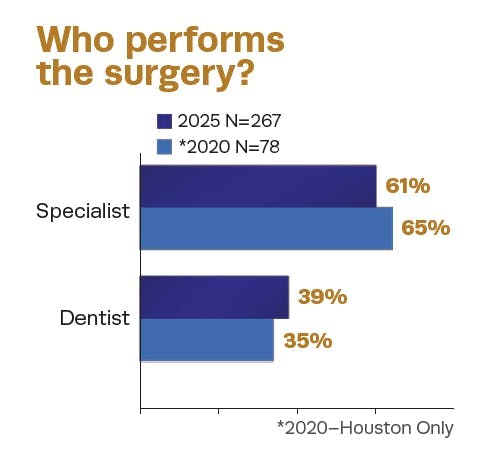
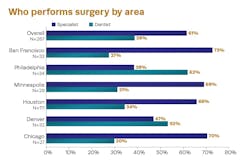
Across all surveyed regions, specialists performed the implant surgery at 61% of the offices, a figure similar to the 65% observed in Houston in 2020. However, in Philadelphia and Denver, general dentists were more likely to perform the surgery, at rates of 62% and 53%, respectively (figures 1, 2).
The analysis revealed a significant difference in the total cost of a dental implant based on the practitioner. The median cost for a complete implant procedure performed by a specialist was $3,400. The median cost for the same procedure performed by a general dentist was $4,800. This indicates that, on average, procedures handled by specialists were substantially less expensive.
National and component pricing averages
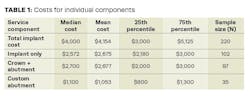
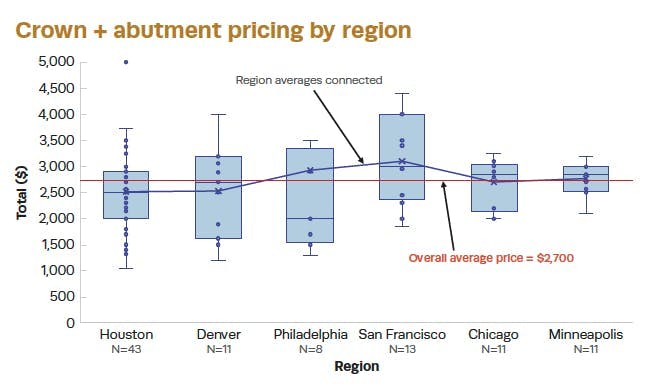
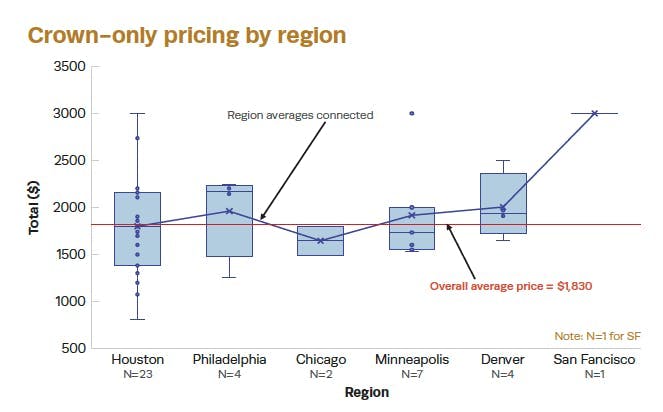
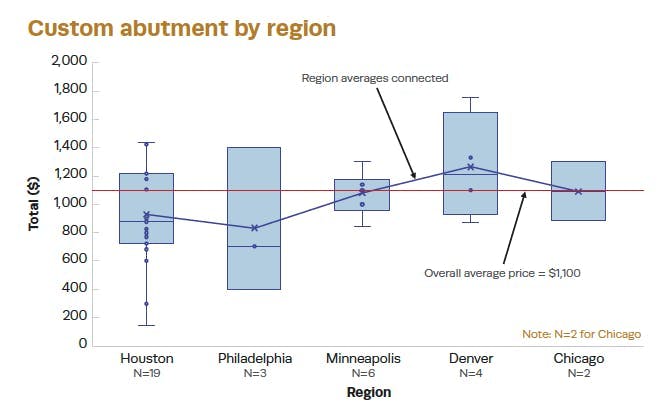
When data from all six metropolitan areas were aggregated, a comprehensive overview of dental implant costs emerged. The median cost for a total implant procedure was $4,000. The costs for individual components are detailed in Table 1.
Regional pricing comparison
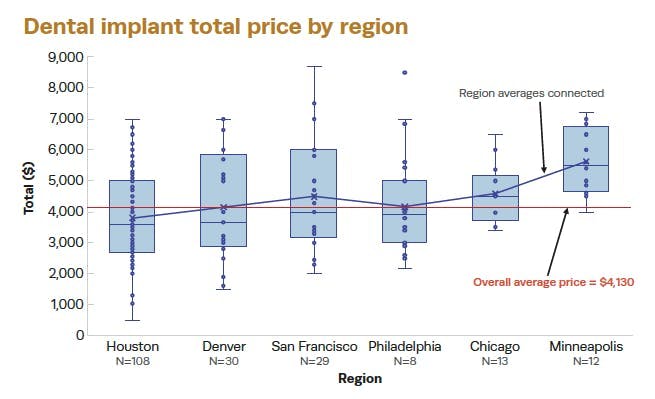
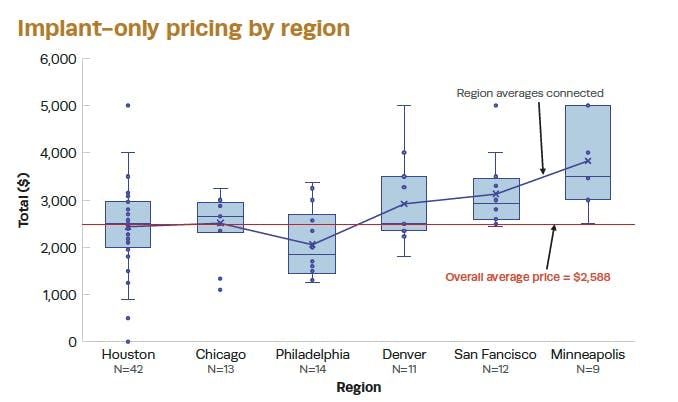
While pricing was generally similar across most regions, Minneapolis stood out as having a significantly higher overall cost for dental implants. Houston, the city with the largest sample size (N=108), had one of the lower median costs The median total costs for each surveyed city are as follows:
- Minneapolis: $5,505
- Chicago: $4,500
- San Francisco: $4,000
- Philadelphia: $3,900
- Denver: $3,833
- Houston: $3,665
Houston pricing: 2025 vs. 2020
The follow-up data from Houston indicated that pricing has remained relatively stable over the past five years. The overall cost for a complete dental implant was slightly less in 2025 than it was in 2020.
Discussion
This multi-city analysis provides valuable economic data for the dental industry. The most striking finding is the significant cost differential between implants placed by specialists and those placed by general dentists. The median cost at offices using a specialist was 29% lower than at offices where a general dentist performed the surgery ($3,400 vs. $4,800). This could be attributed to several factors, including higher case volume leading to greater efficiency, established workflows with restorative partners, and different fee structure philosophies.
The regional variation, particularly the high cost in Minneapolis, highlights the impact of local market dynamics on dental pricing. Factors such as regional cost of living, practitioner density, and prevailing insurance reimbursement rates likely contribute to these differences.
Limitations of this study include the sparse pricing information for some components and regions. For instance, the data for a crown only in San Francisco was based on a single response (N=1), making it unreliable for generalization. The overall number of responses from the five new metropolitan areas was also relatively small (approx. 30 each) compared to Houston. Future research with larger sample sizes would provide more robust regional comparisons.
Conclusion
The 2025 survey of dental implant pricing demonstrates that costs are influenced more by practitioner type and geographic location than any single national trend. The key takeaways are that specialist-performed implant surgeries are associated with a significantly lower median cost, and that substantial price disparities exist between different US metropolitan areas. These findings can serve as a valuable benchmark for dental practices in evaluating their fee structures and for educating patients on the potential range of costs for implant treatment.
Editor's note: This article appeared in the February 2026 print edition of Dental Economics magazine. Dentists in North America are eligible for a complimentary print subscription. Sign up here.
About the Author
 Steve L. Koo, DDS
Steve L. Koo, DDS
Steve L. Koo, DDS, is a diplomate of the American Board of Oral and Maxillofacial Surgery, a fellow of the American College of Oral and Maxillofacial Surgery, and chief of oral and maxillofacial surgery at Memorial Hermann at Memorial City. He joined Dr. Thomas Weil in 2007 as a partner to form Piney Point Oral & Maxillofacial Surgery of Houston and has been practicing for over 30 years. For more information, visit www.pineypointoms.com.
Julie Mai
Julie Mai graduated from University of Houston in 2022 with a Bachelor of Arts in Psychology, and a minor in Public Health. She joined Piney Point Oral & Maxillofacial Surgery of Houston as an administrative assistant in 2023 and takes great pride in being part of the team. For more information, visit pineypointoms.com or email her at [email protected].