Is SEO dead? Why GEO matters for dentists
Key Highlights
- GEO is the evolution of SEO, tailored to optimize visibility in AI-generated search results and voice searches.
- Key GEO strategies include detailed 'About' pages, FAQs, patient education content, and building a reputable brand through authoritative links.
- Technical website improvements like fast loading times and structured data are essential for AI bots to effectively parse your content.
- Consistent content updates and active social media engagement help reinforce your practice’s relevance and reputation.
- While organic traffic declines due to AI summaries, strategic paid ads and optimized GEO practices can help attract new patients.

Every day more people search using generative AI tools like ChatGPT instead of a standard Google search. As much as 80.92% more people have done so this year over last year by some estimates.1 Even when using Google.com, people are relying on AI overviews much of the time. Because of this, a zero-click marketing strategy—one that doesn’t rely on prospective patients arriving at your website—is emerging as a new strategy for practice growth. Generative engine optimization (GEO) is a key component to zero-click marketing success.
What is GEO?
GEO is the successor of SEO (search engine optimization). In many cases, dental practices are enjoying visibility in the generative results produced by the AI-powered, large language model (LLM) tools. Google Gemini, ChatGPT, Perplexity, and many others favor these practices because of the success of their good reputation and SEO. Dentists can boost their likelihood to get picked up by LLMs using SEO strategies, refined for the AI age, in a few key areas. These refined SEO principles are essentially GEO.
While GEO has little to do with keywords, modern SEO principles still apply. GEO success will come more from the substance of your website in combination with the overall reputation of you and your practice—your brand, in other words. To be successful in GEO, your practice will have:
- An “About” page on your website that describes you, your experience, credentials, and accolades in detail.
- FAQs and service pages on your website that answer common questions and patient concerns.
- A “Patient Education” or blog section that goes more in depth on these topics while still describing them in the context of your practice (e.g., how you solve the patient problems, not general information on tech or procedures).
- A brand that is mentioned and linked alongside other leaders in dentistry, other authoritative dental entities, or local organizations with a good reputation.
Other SEO tactics coopted by GEO
If the emphasis on content, links, and reputation sounds familiar, you’ve probably researched SEO before. Good content and proper organization have always facilitated good Google rankings. Now these same strategies are also part of GEO, but are focused more on appealing to the natural language processing used in these AI systems. These SEO-turned-GEO tactics will help your practice improve its visibility in generative results, including voice search:
- Maintain a fast website that is easy for bots to use. Tell your web company you want to make sure you’re using structured data in your website’s coding.
- Get links from authoritative and local websites. Don’t pay for them, but be relevant and, when you’re mentioned, ask for a link to your website.
- Create good, original content. Fancy, low-text websites are some of the biggest losers in GEO.
- Become a recognizable brand in your city. It’s more important than ever.
What you can do to improve GEO
“Be relevant” might have struck you as funny or infuriating. How can a dentist just “be relevant” especially when you want visibility now? It does take time to develop a strong reputation. In the meantime, hire a company that is known for great content and SEO, because they are the leaders in GEO now, especially if they also have a nose for high-tech, high-performance websites. This way, if a potential patient types something like “who is the best dentist in Irvine for cosmetic veneers?” your brand will be more likely to show up.
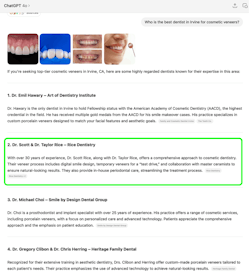
Your marketing people should have already filled your website with content that was written from scratch exclusively for your dental practice. Then, they should add original content that answers the questions patients are asking these generative tools. Your website needs to be optimized so that the bots that find content and feed it to the LLMs can easily navigate it and parse through its information.
Your marketing company should also have a comprehensive approach to spreading the word about your brand. These consistent updates to your website should be shared, along with other informative posts and personal content, on social media, your Google profile, and other local opportunities you can find.
Generative results make ads more important than ever
When a potential patient makes a search today, they may never reach your website. They will get the answer to their question, and hopefully your name. If they are ready to get treatment, they’ll look for your phone number or booking link, and they can find both without visiting your website. This doesn’t make websites obsolete, but it does mean that your marketing needs to be ever-present. Google’s AI Overview and Gemini, Google’s AI chatbot, and the other LLM search tools are siphoning off traffic from websites at an alarming rate—as much as 34% for some websites, according to Ahrefs, a search marketing tool provider.2 AI Overview results combined with ad placements, featured snippets, and other Google search result components have continued to devalue organic Google rankings for dentists.
Google has included an AI Overview on more and more of their search results, showing it as much as 91% more in the past six months.3 Rest assured that Google will not abandon its cash cow, Google Ads, just to leverage AI in the user experience. Consequently, the value of a well-managed Google Ads campaign will only increase as organic results are pushed farther down the page. If your organic SEO was bringing meager traffic to your website to begin with, unfortunately, you have every reason to expect this to get worse according to some studies and the basics of human behavior.1 Why would users continue to scroll down the results and click to the bowels of Google when a convenient, informative result is at the top of the page? Savvy marketing companies can help you capture this new wave of interest, conveying a share of the growing percentage of AI-equipped searchers into your exam rooms, by leveraging a combination of SEO, GEO, and well-placed ads.
Editor's note: This article appeared in the September 2025 print edition of Dental Economics magazine. Dentists in North America are eligible for a complimentary print subscription. Sign up here.
References
- Sarkar S. Are AI chatbots replacing search engines? A 2-year data study on web traffic trends. One Little Web. Updated April 22, 2025. Accessed May 5, 2025. https://onelittleweb.com/ai-chatbots-vs-search-engines/
- Goodwin D. New data: Google AI Overviews are hurting click-through rates. Search Engine Land. April 21, 2025. Accessed May 5, 2025. https://searchengineland.com/google-ai-overviews-hurt-click-through-rates-454428
- Guaglione S. Measuring Google's AI Overviews' impact: Why keyword data is more telling than CTRs for publishers. Digiday. March 19, 2025. Accessed May 5, 2025. https://digiday.com/media/measuring-googles-ai-overviews-impact-keyword-data-ctrs-for-publishers/
About the Author
 Jonathan Fashbaugh
Jonathan Fashbaugh
Jonathan Fashbaugh is the president of Pro Impressions Marketing. He advises dental offices nationwide on SEO, advertising, and patient acquisition. He is the author of The Marketing Mix That Works: A Comprehensive Marketing Manual Designed to Help Dental Offices Grow, coauthor of The TMJ Trifecta: Solving Your Pain Puzzle, and is a frequent contributor to dental industry publications, including Dental Economics.