Key Highlights
- Delaying practice ownership can cost dentists millions in lifetime earnings due to lost compounding income.
- Most dentists will eventually own a practice, but the timeline delay significantly impacts financial outcomes.
- The myth that student loans are a barrier to ownership is false; owning a practice is the fastest way to pay them off and build wealth.
- A simple two-question test—about location and last year's collections—can help dentists evaluate practice opportunities efficiently.
- The key to success is acting when informed, not waiting for the perfect moment or feeling fully ready.

“I don’t feel ready to buy a practice yet…” says every associate.
I have bad news. If you wait until you “feel” ready for ownership, you’ll never buy. And that decision will cost you millions of dollars in career earnings.
I’ve helped about 1,500 dentists successfully transition into practice ownership in almost every state. In that time, the single most common mistake I saw wasn’t buying the wrong practice. It was not buying one at all.
The “wait until I’m ready” strategy is everywhere right now.
Ownership isn’t disappearing. It’s just being delayed.
Here’s something the doom-and-gloom headlines about DSO consolidation tend to miss: practice ownership is still the endgame for most dentists. Data from the ADA Health Policy Institute makes this clear.
Among dentists who graduated between 1991 and 1995, roughly 65 to 70% owned their practice within their first five to nine years out of school. For the class of 2016–2020, that number is just 21% at the same career stage.1
But here’s the critical nuance: by the 25-plus-year mark, ownership rates across all graduating classes converge toward 90%. The destination hasn’t changed. The timeline has.
That gap—the extra years spent as an associate before making the jump—is where the damage happens.
What delayed ownership actually costs you
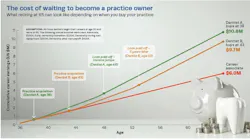
Consider three dentists who all graduate at age 36 and plan to retire at 65. One buys a practice at 38. The second waits until 43, just a five-year difference in timeline. The third spends their entire career as an associate.
Let’s assume the true average difference in associate salary compared to average take-home pay of owner doctors–almost $150,000.2
By retirement, the dentist who bought at 38 has accumulated $10.8 million in cumulative career earnings. The one who waited until 43? $9.7 million. The career associate? $6.0 million.
That’s a $4.8 million gap between buying early and never buying at all, and a $1.1 million penalty for waiting just five years. These aren’t projections built on optimistic assumptions—they’re the straightforward result of what ownership income compounds to over a career, once the acquisition loan is paid off and earnings accelerate.
Notice what happens when each dentist pays off their acquisition loan: income jumps sharply. The early buyer hits that inflection point at 38. The dentist who waited didn’t get there until 48. That 10-year gap in reaching debt-free ownership is where the divergence becomes permanent.
It’s not just about what you’re not earning. Every year you spend as an associate, you’re building equity for someone else. In an era of accelerating DSO consolidation, “someone else” increasingly means a private equity firm, not a retiring dentist who built something over decades.
Associates who wait until they “feel ready” aren’t playing it safe. They’re subsidizing other people’s wealth-building with their fear.
The myth that’s keeping associates stuck
The most common piece of bad advice for young dentists today is you need to get on top of your student loans before you buy a practice. It sounds responsible. It is not.
Dental practice loans are the second safest loans on the planet (behind funeral homes). Your student loan balance is rarely the obstacle you’ve been told it is. The hard truth is that the best way to feel on top of your student loans is to make a lot of money, and the fastest way to make money in dentistry is to own your practice.
The real obstacle is usually uncertainty. Dentists don’t know how to evaluate a practice quickly, so they delay. They wait for more information, more confidence, or a better market. Meanwhile, the practices they could have bought three years ago are now owned by someone else.
The two-question lemon test: A faster path to clarity
After years of guiding buyers through acquisitions, I’ve found that most practices can be meaningfully prequalified with just two questions asked and answered honestly before you spend a dollar on formal due diligence.
1. Does the dentist actually want to live there? Location is the one variable you cannot fix after closing. You can improve systems, upgrade equipment, and grow production, but you cannot move the practice. More importantly, do you and your family genuinely want to build a life in that community? A dentist who is deeply embedded in the place they serve builds a different kind of practice than one who is already planning their exit.
2. How much did that practice collect last year? Collections are the most honest number in any practice’s financials. Not production. Not EBITDA. What actually came in. This single figure tells you a lot about whether the asking price is defensible, what debt service you can realistically carry, and whether the practice is growing or quietly declining. Ask for three years of collections. If the seller hesitates to share them, that's also data.
These two questions don’t replace due diligence; they make diligence more efficient. If both answers are solid, you engage a buyer-focused CPA to go deeper. If either answer gives you pause, you know exactly what to probe before going further.
Stop waiting for ready
The data is clear; ownership is still where most dentists end up. The question is how quickly you’ll get there, and who you make rich along the way. A boss, or yourself?
Every year you wait is a year of someone else’s equity, a year of foregone owner income, and a year of compounding opportunity cost. The “perfect time” to buy a dental practice does not exist. The right time is when you’re informed enough to move, and that preparation takes weeks, not years.
Stop asking if you feel ready to buy a practice. The only way to feel ready is to do it. If the goof-off classmate in your dental school who you would never let near your teeth can buy and run practice (and I bet they do), you can face the fear and jump into ownership, too.
Editor's note: This article appeared in the June 2026 print edition of Dental Economics magazine. Dentists in North America are eligible for a complimentary print subscription. Sign up here.
References
-
HPI: Younger dentists still become practice owners, just later in careers.” American Dental Association. June 2025. ADA News. https://adanews.ada.org/ada-news/2025/june/hpi-younger-dentists-still-become-practice-owners-just-later-in-careers/.
-
Hanks B. Dental practice owners make a LOT more money. YouTube. https://www.youtube.com/shorts/KlC3McegX4M
About the Author
Brian Hanks, MBA, CFP
BRIAN HANKS, MBA, CFP, is a buyer advocate who has helped hundreds of dentists purchase dental practices. He is passionate about helping educate dental practice buyers. Hanks can be reached through his website, brianhanks.com.