Product Watch: New restorative products target workflow, esthetics, and durability
For dental practices, new products are rarely just about the material or instrument itself. The larger question is whether they can help clinicians work more efficiently, standardize protocols, reduce remakes or chair time, and maintain predictable outcomes. Recent launches in restorative dentistry and endodontics show how manufacturers are positioning new products around those goals, with claims tied to esthetics, durability, antimicrobial activity, bulk-fill efficiency, and canal access.
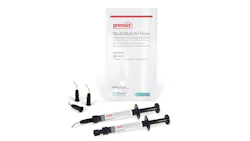
Premier launches antimicrobial flowable composite
What launched: Premier Dental has announced the launch of MultiMatch Flow Chameleon Antimicrobial Composite with BioArmor Technology.¹
Product category: Flowable antimicrobial composite.
Indications: The new composite is cleared by the FDA and was designed by Premier Dental for direct restorations in cavity classes I-V. Premier Dental reports the product is indicated for direct restoration, discolorations, splinting of mobile teeth, composite and ceramic veneers repair, and retention of thermoplastic aligners. The material is also indicated for use as a base or liner under direct restorations and for extended pit and fissure sealing.
What the company says: Premier Dental reports that by adding antimicrobial particles, the material is designed to reduce demineralization and lead to less bacteria on the material surface. BioArmor uses nano-silica particles containing octenidine dihydrochloride (OCT), which Premier Dental reports is designed for controlled release.
Additional features: The company reports that the composite is formulated with a universal shade system through its EZ-Blend shade system. The company also reports that the material has self-leveling properties and is intended to support marginal integrity and long-term durability.
Clinical perspective: Restorative dentistry has shifted its focus from simply replacing lost tooth structure to developing materials that actively support long-term oral health. While no restorative material can replace meticulous clinical technique or comprehensive caries management, innovations like these reflect the profession’s growing emphasis on prevention, minimally invasive dentistry, and extending the longevity of restorations. As with any new material, clinicians should evaluate the available evidence and determine how these technologies may fit into evidence-based patient care.
What to evaluate: Clinicians should consider what evidence supports the antimicrobial claim, how the material performs in real clinical conditions, and whether it fits their existing restorative protocols.

Dandy adds esthetic characterization for zirconia restorations
What launched: Dandy has launched Polychromatic Shade, a patented technology designed to add color characterization and esthetic features to monolithic zirconia restorations.²
Product category: Zirconia restoration esthetics / digital restorative workflow.
Why it matters: Zirconia is commonly used for fixed restorations because of its strength, durability, and biocompatibility, but esthetics can be a consideration when clinicians are deciding among restorative materials. Dandy is positioning Polychromatic Shade as a way to improve the appearance of monolithic zirconia while maintaining its strength and cost-effectiveness.
What the company says: According to Dandy, Polychromatic Shade uses a patented robotic stain and glaze process that applies color characterization to the restoration with micron-level accuracy. The company states that the result is a more natural color gradient and translucency while still maintaining a high-strength zirconia substrate.
Practice impact: Dandy reports that Polychromatic Shade crowns are available for $99, with a lifetime warranty, no fees for remakes, and a delivery time of five days.
Clinical perspective: Patients demand highly esthetic restorations, and innovations that enhance the appearance of monolithic zirconia without compromising its strength are especially noteworthy. Technologies that improve shade gradients, translucency, and characterization may help clinicians deliver more lifelike results while maintaining the durability, efficiency, and cost-effectiveness that have made zirconia a commonly used restorative material. As digital workflows continue to evolve, advancements like these may support patient satisfaction, restorative outcomes, and practice efficiency.
What to evaluate: Clinicians should consider where enhanced zirconia esthetics fit within their restorative material selection, especially when weighing strength, translucency, cost, turnaround time, case location, and patient expectations.
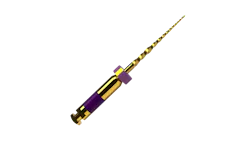
Dentsply Sirona launches WaveOne Gold Orifice Shaper
What launched: Dentsply Sirona has launched the WaveOne Gold Orifice Shaper, the company’s first reciprocating coronal flaring instrument.³
Product category: Endodontic instrument / root canal preparation.
Why it matters: Coronal flaring can help improve access to the canal system and support a more efficient root canal workflow. This instrument is designed to fit within the existing WaveOne Gold system, allowing clinicians to use the same reciprocating motion and motor settings.
What the company says: Dentsply Sirona states that the instrument is intended to assist with coronal flaring and improve access to the canal system. According to the company, the instrument can help reduce shaping time by 23% compared with procedures without an orifice shaper and can improve access to root canals through early dentin triangle removal.
Workflow impact: The instrument was developed to preserve familiarity within the WaveOne Gold system while adding a dedicated option for coronal flaring. Dentsply Sirona reports that it was developed with input from clinicians and clinical education lecturers from Europe and the United States.
Clinical perspective: Instruments designed to improve coronal flaring while preserving a familiar workflow can help clinicians gain straighter-line access, reduce procedural time, and facilitate more effective cleaning and shaping of the root canal system. As endodontic technology continues to advance, innovations that simplify treatment while enhancing efficiency have the potential to improve both the clinician’s experience and patient outcomes.
What to evaluate: Clinicians should consider how a new orifice shaper fits into their existing endodontic protocol, including case selection, training, irrigation strategy, motor settings, and whether the claimed time savings translate into predictable clinical results.
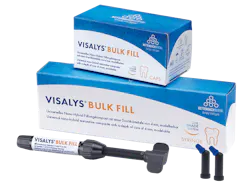
Kettenbach expands Visalys line with bulk-fill composite
What launched: Kettenbach Dental has expanded its composite portfolio with Visalys Bulk Fill, a packable bulk-fill material designed for posterior restorations.⁴
Product category: Packable bulk-fill composite / restorative workflow.
Why it matters: Bulk-fill composites are intended to simplify restorative workflows by allowing larger increments while maintaining the handling and performance characteristics clinicians expect from direct restorative materials. According to Kettenbach Dental, Visalys Bulk Fill is designed to support simplified placement for posterior restorations.
What the company says: The company reports that the material has low water absorption, low polymerization shrinkage stress, and abrasion resistance intended to support restoration durability. The material is designed for single-layer placement applications up to 4 mm and has a reported low water absorption of 9.8 µg/mm³.
Additional features: Visalys Bulk Fill uses a one-shade concept, which Kettenbach Dental says is intended to help the material integrate into the natural tooth without complex shade selection. The company lists indications including Class I to Class V restorations, pediatric fillings, and core build-ups.
Workflow impact: Kettenbach Dental has integrated the new composite within its existing Visalys product line, including Visalys Bulk Flow, as the company aims to offer a more coordinated system for users.
Clinical perspective: Selecting a restorative material is about more than convenience; it requires balancing efficiency, predictability, esthetics, and physical properties that support long-term clinical success. Bulk-fill composites continue to evolve by offering simplified placement techniques while addressing concerns such as polymerization shrinkage, wear resistance, and marginal integrity. As clinicians evaluate new materials, innovations that reduce chair time without compromising esthetics or durability can help streamline restorative workflows and support consistent, high-quality restorations for patients.
What to evaluate: Clinicians should consider whether the one-shade concept meets their esthetic needs, how the material performs in posterior applications, and whether the promised workflow simplification aligns with their existing placement, curing, finishing, and case-selection protocols.
More on composites and restoratives

 rethinking periodontal care
References
1. Premier Dental. MultiMatch™ Flow Chameleon Antimicrobial Composite with BioArmor Technology. Press release. May 4, 2026
2. Dandy. Dandy unveils Polychromatic Shade™ to end the trade-off between dental aesthetics and affordability. Press release. July 14, 2026.
3. Dentsply Sirona. New from Dentsply Sirona: Orifice shaper expands the WaveOne Gold file system for efficient coronal flaring with reciprocating motion. June 10, 2026. https://www.dentsplysirona.com/en-us/why-ds/about-ds/newsroom/news-details.html/content/dam/master/news/en/business-units/endodontics/2026/new-from-dentsply-sirona--orifice-shaper-expands-the-waveone--gold-file-system-for-efficient-coronal-flaring-with-reciprocating-motion
4. The new restorative composite Visalys Bulk Fill – for durable restorations within a system. Press release. April 22, 2026.
Clinical input from Pamela Maragliano, DMD, Editor in Chief
About the Author
Bridget Janis
Bridget Janis is a staff writer at Endeavor Business Media’s Dental Group, where she reports on clinical, industry, and public health topics for leading dental publications. She holds a bachelor’s degree in journalism from Oakland University in Rochester, Michigan, and is focused on producing clear, engaging, and informative content for dental professionals.