Preventing peri-implant disease: What the latest evidence demands of every clinician
Key Highlights
- Prevent risk before placement: Address periodontitis, smoking, glycemic control, and prosthetic design before implant placement to reduce peri-implant disease risk.
- Make maintenance risk-based: Individualized supportive peri-implant care, including probing, biofilm removal, and home-care reinforcement, is essential for long-term implant health.
- Use air abrasion strategically: Evidence supports glycine and erythritol powders for effective implant biofilm removal with minimal surface alteration, while established peri-implantitis may require additional treatment.
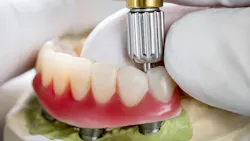
Peri-implant mucositis affects a substantial proportion of implant patients. If unmanaged or inadequately treated, it can progress to peri-implantitis, leading to progressive bone loss that may ultimately threaten implant survival.1,2 Key risk factors include a history of periodontitis (consistently identified as one of the strongest predictors), smoking, uncontrolled diabetes, poor biofilm control, implant malposition, and unfavorable prosthetic design.2,3 As implant placement continues to grow, clinicians are increasingly challenged not only with achieving successful osseointegration but also with maintaining long-term implant health. Regular supportive peri-implant care (SPIC) plays a critical role. The value of regular maintenance is well documented. One study shows peri-implantitis rates of 18% among patients enrolled in maintenance programs, compared with 43.9% among patients who are not.4
Prevention begins before placement
The European Federation of Periodontology (EFP) S3 Clinical Practice Guideline emphasizes that prevention must begin before implant placement. This includes comprehensive risk assessment, treatment of existing periodontitis to a stable endpoint, smoking cessation, optimization of glycemic control, and enrollment in supportive periodontal care before surgery.2
Equally important is restorative planning. Prosthetic contours should facilitate effective patient hygiene and clinician access for probing and debridement. Emergence profiles that promote plaque accumulation are modifiable risk factors and are often best addressed during treatment planning.2,3
Structured maintenance: The cornerstone of longevity
SPIC combines manual instruments with mechanical biofilm removal devices, including air polishing systems. SPIC remains one of the most important contributors to long-term implant success. Research shows that individualized, risk-based maintenance protocols consistently improve probing depths and bleeding on probing compared with fixed-interval or no maintenance programs.4
A multicenter study involving more than 3,500 implants demonstrated significantly improved implant survival among patients with a history of periodontitis who participated in supportive therapy. Based on these findings, the recommendation was made for two to three maintenance visits annually for high-risk individuals.4 Current evidence supports recall intervals of every three to six months for moderate- to high-risk patients and up to 12 months for low-risk individuals.2,3 The Implant Disease Risk Assessment (IDRA) tool provides a structured framework for determining individualized maintenance intervals.3
Each maintenance appointment should include:
- 6-point peri-implant probing
- Assessment of bleeding on probing and suppuration
- Plaque evaluation
- Professional biofilm removal
- Reinforcement and modification of oral hygiene instruction
- Radiographic evaluation when clinically indicated3,4
Home care remains foundational and should include twice-daily toothbrushing, interproximal brushes, and specialty floss or water irrigators for patients with complex prosthetic designs.2,3
Air abrasive instruments: An important advancement in peri-implant maintenance
Current evidence strongly supports incorporating air abrasive devices into routine supportive periodontal maintenance protocols, particularly those that utilize glycine powders. The 2025 American Academy of Periodontology/Academy of Osseointegration systematic review concluded that air-powder abrasive devices achieved among the highest levels of biofilm removal from implant surfaces while producing minimal alterations to implant surface characteristics. This ranks them among the closest available approaches to an ideal decontamination protocol.5
A randomized clinical trial demonstrated that glycine air abrasive debridement produced an earlier onset and more sustained improvements in bleeding indices and probing depths compared with ultrasonic instrumentation. Significant clinical improvements persisted for three months versus approximately three weeks following ultrasonic therapy.6 In vitro investigations similarly demonstrated that erythritol powder left substantially less residual biofilm than PEEK ultrasonic tips (41%) or titanium curettes (55%), while producing minimal implant surface damage.1
One important caveat should be recognized. The EFP S3 guideline does not recommend air polishing as submarginal monotherapy for the nonsurgical treatment of established peri-implantitis because the available evidence remains insufficient.2
Bottom line
Peri-implant disease is largely preventable, and prevention starts before the implant is placed. Comprehensive risk assessment, prosthetic designs that facilitate effective hygiene, individualized supportive maintenance, and ongoing patient education all play important roles in implant success. Air abrasive instruments represent an evidence-supported advancement in professional biofilm management by providing efficient, implant-safe decontamination that complements conventional mechanical debridement. Every implant placed carries a lifelong maintenance obligation.
Editor's note: This article appeared in the October 2026 print edition of Dental Economics magazine. Dentists in North America are eligible for a complimentary print subscription. Sign up here.
References
- Eraydin-Tufek N, Ozcan G, Isler SC. Efficacy of different nonsurgical treatments for peri-implantitis: a multi-arm randomized controlled clinical trial. Sci Rep. 2026;16(1):20370. doi:10.1038/s41598-026-50332-5
- Herrera D, Berglundh T, Schwarz F, et al. Prevention and treatment of peri-implant diseases—the EFP S3 level clinical practice guideline. J Clin Periodontol. 2023;50(suppl 26):4-76. doi:10.1111/jcpe.13823
- Wang HL, Avila-Ortiz G, Monje A, et al. AO/AAP consensus on prevention and management of peri-implant diseases and conditions: summary report. J Periodontol. 2025;96(6):519-541. doi:10.1002/JPER.25-0270
- Wang HL, Calatrava J, Soldini MC, et al. Long-term periodontal and peri-implant tissue stability under supportive therapy. Periodontol 2000. 2026. Published online: April 9, 2026. doi:10.1111/prd.70038
- Ravidà A, Dias DR, Lemke R, Rosen PS, Bertolini MM. Efficacy of decontamination methods for biofilm removal from dental implant surfaces and reosseointegration: an AAP/AO systematic review on peri-implant diseases and conditions. Int J Oral Maxillofac Implants. 2025;(suppl 4):91-160. doi:10.11607/jomi.2025suppl40
- Partido B, Saraswat S, Kumar PS. Impact of glycine powder air-abrasive debridement on peri-implant mucositis: a randomized controlled trial of clinical, microbial, and immunological changes. Clin Oral Implants Res. 2025;36(1):82-91. doi:10.1111/clr.14361
About the Author
Kevin R. Suzuki, DMD, MS
Kevin R. Suzuki, DMD, is a Seattle-area periodontist and oral implantologist. He completed his dental training at Nova Southeastern University and his periodontology residency at Temple University. Dr. Suzuki is a diplomate of the American Board of Periodontology and the International Congress of Oral Implantologists and a fellow of the American College of Dentists. He serves on the faculties of the University of Washington School of Dentistry and Temple University’s Graduate Periodontology Department.