The neural and emotional instrument: Integrating cognitive load theory and emotional intelligence in modern dentistry
Key Highlights
- High visual demands, procedural uncertainty, and constant task-switching can contribute to cognitive overload, decision fatigue, and diagnostic errors in dental practice.
- Integrating magnification, four-handed dentistry, ergonomic workspaces, and distraction management helps protect clinical focus and precision.
- Emotional intelligence and practical self-regulation techniques, including the 3-2-5 breathing routine, support clinician well-being, patient safety, and long-term career sustainability.
Dentistry demands intense cognitive engagement, manual dexterity, and continuous visual processing within a highly confined operative field. While clinical training focuses heavily on technical hand skills, the neuroergonomic and emotional limits of the clinician are rarely addressed.
This literature review synthesizes the neurochemical and physiological challenges of dental practice, examining how high visual demands and procedural uncertainty trigger prefrontal cortex overload, inattentional blindness, and decision fatigue. Furthermore, it addresses the illusion of chairside multitasking, highlighting the cognitive and manual costs of rapid task-switching alongside downstream somatic dysregulation.
To mitigate these occupational threats, an integrated macroergonomic framework is proposed. This approach combines mechanical and team ergonomics—such as strict four-handed dentistry, coaxial micromagnification, and customized loupes—with real-time somatic regulation protocols rooted in emotional intelligence (EQ).
By establishing emotional and physical self-awareness as a core clinical competency, practitioners can safeguard patient safety, reduce diagnostic errors, and ensure long-term career sustainability in contemporary, fast-paced dental environments.
Task complexity and the neurological toll of visual certainty
Dentistry demands simultaneous manual dexterity and intense cognitive engagement within the confined, dark, and humid environment of the oral cavity.1 Operating at the absolute edge of human visual resolution triggers a massive neuroergonomic compensation.
The requirements for visual accuracy make the use of high-magnification tools—such as loupes and dental microscopes with multiple magnification levels and coaxial lighting—essential across all dental disciplines. Precision in practice also depends on effective teamwork; ergonomic support for the upper limbs, lower back, and hips through specialized stools; the use of indirect vision; and, most importantly, education on work behaviors. Organizational criteria should be established to address the challenges of the profession and should be integrated with cognitive strategies.2
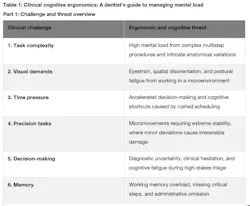
When diagnostic or procedural uncertainty is high, the clinician’s brain undergoes predictable shifts in performance (table 1):3
- Prefrontal cortex overload: When weighing complex clinical evidence under time pressure, the brain doesn’t simply run out of fuel. Instead, prolonged cognitive labor causes an excessive buildup of the neurotransmitter glutamate in the lateral prefrontal cortex. This chemical overload increases the metabolic cost of thinking, forcing a defensive shift toward low-effort, impulsive choices—the true biological root of acute decision fatigue.4
- Inattentional blindness: The brain dedicates roughly 44% of its energy to visual processing.5 Under extreme visual strain, the occipital cortex monopolizes cerebral metabolism, starving peripheral frontoparietal neural networks.6 This explains why exhausted professionals experience inattentional blindness—completely failing to see glaring anomalies right in front of them. This failure is severely exacerbated in dental practice when working with the naked eye or inadequate loupes. Forcing continuous, extreme ocular accommodation to discern micrometric details rapidly drains central cognitive resources, locking the practitioner into a dangerous blind spot.7,8
- Predictive "top-down" processing: When a visual field is highly uncertain, the brain ceases to rely on data-driven, bottom-up inputs. To compensate, it shifts to a predictive processing mode, leaning heavily on prior experiences and biases.9 The brain literally "fills in the blanks," making the professional see what they expect to see rather than the true clinical reality.
- Cognitive errors and premature closure: To escape the neurochemical discomfort of prolonged cognitive overload, the brain becomes highly susceptible to the "satisfaction of search" (SOS) error.10,11 Once the eye finds one minor abnormality or satisfies the immediate procedural step, the brain experiences premature closure and stops looking entirely—frequently missing secondary, more critical diagnoses.
The illusion of multitasking vs. somatic dysregulation
Contemporary neuroscience proves that true multitasking is a psychological illusion; the human brain is incapable of parallel processing for independent complex tasks. What clinicians experience as multitasking is actually rapid, resource-heavy task-switching.12
The cost of task-switching
Switching focus from the operative field to check digital charts, respond to a team member, or manage administrative delays forces a "task-set reconfiguration." This creates a cognitive lag time (switching cost) that fragmentizes working memory, dilutes procedural efficiency by up to 40%, and disrupts the corticospinal tracts responsible for high-precision manual micromovements.13-15
Somatic dysregulation at chairside
When cognitive capacity is overstretched, the body responds before the conscious mind can explain the threat. The amygdala runs its threat-detection circuit and dumps cortisol into the bloodstream.16,17 This neurological strain manifests as distinct somatic signals—clenched jaws, locked shoulders, shallow thoracic breathing, and an internal monologue that shifts from neutral to highly critical.18
Furthermore, somatic pain acts as an intrusive sensory distraction.19 High postural loading slows reaction times and limits diaphragmatic lung expansion, directly reducing optimal oxygenation to the neural tissues already fighting visual and decision fatigue.20
Emotional intelligence (EQ) as a macroergonomic tool
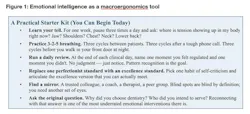
The gap between what a dentist is trained to do and the human being who must execute the procedure is where emotional intelligence lives. EQ is the capacity to notice, understand, and regulate our internal state.21 It is structured on a foundational axiom: awareness before control. Clinicians cannot regulate a nervous system state they have not consciously noticed (figure 1).18
Chairside coregulation: The nervous system ecosystem
A dentist’s internal state is a hidden clinical variable. Patients and dental teams constantly read the clinician's microexpressions and body language. Because of coregulation—a measurable neurophysiological phenomenon in which one autonomic nervous system entrains another22—a dysregulated, anxious clinician communicates threat to the room, provoking a stressed assistant and defensive patients. Conversely, an emotionally regulated clinician communicates visceral safety, which stabilizes team coordination, decreases patient distress, and directly lowers clinical error rates.
Shifting from perfectionism to clinical excellence
Of all chronic stressors in dentistry, perfectionism is the most destructive. Perfectionism is unattainable by definition because health-care outcomes are heavily mediated by biology, anatomy, and host responses. Striving for perfection causes chronic self-flagellation and burnout.23 This systematic exhaustion is heavily documented across modern dental practitioners and medical providers alike.24
In contrast, clinical excellence is a sustainable standard. Excellence lives entirely within the clinician's effort, preparation, intention, and presence. Replacing perfectionism with excellence preserves professional rigor while removing structural self-punishment.
The integrated action plan for dental practices
To mitigate cognitive load and maximize somatic regulation, dental practices must implement an integrated framework of mechanical ergonomics and behavioral practices.
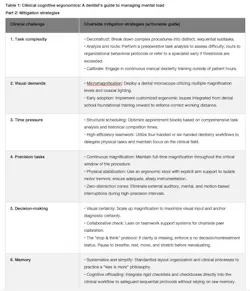
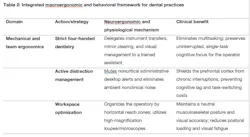
Mechanical and team ergonomics (table 2)
- Strict four-handed dentistry: Utilize a highly trained assistant to establish a strict division of labor. The assistant manages instrument transfers, mirror clearing, and visual clearance, allowing the operator to maintain an uninterrupted, single-task focus.
- Active distraction management: Mute noncritical administrative desktop notifications and eliminate ambient nonclinical disruptions to shield the clinician from chronic prefrontal cortex interruption.
- Workspace optimization: Organize the operatory based on horizontal reach zones (constant, frequent, and occasional use) and utilize high-magnification ergonomic loupes or microscopes to preserve neutral posture and visual accuracy.
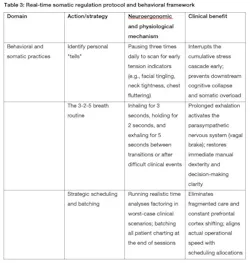
Real-time somatic regulation protocol (table 3)
- Identify your personal "tell": Pause three times a day to identify where tension accumulates in your body (e.g., tingling across the face, neck tightness, or a flutter in the chest). Catching this cascade early prevents downstream cognitive collapse.
- The 3-2-5 breath routine: Execute this portable tool between patient transitions, after difficult calls, or before entering the operatory. Inhale through the nose for a count of 3, hold for 2, and exhale slowly for 5. The prolonged exhalation engages the parasympathetic branch of the autonomic nervous system, serving as an immediate neurological brake to restore manual dexterity and decision-making clarity.
- Strategic scheduling and time analysis: Align your actual operational speed with scheduling allocations by running realistic time analyses that factor in worst-case clinical scenarios. Batch all patient charting at the end of morning and afternoon sessions to prevent fragmented care.
Conclusion
The most important patient a dentist will ever treat is themselves. If we do not provide ourselves with the same clinical care, neurological rest, and compassion that we extend to our patients, our careers become unsustainable. By integrating human factors, neuroergonomics, and emotional intelligence into dental education and daily practice, we safeguard both clinical outcomes and practitioner well-being. Technical proficiency preserves oral health, while emotional and somatic awareness supports the clinician.
The reality is, dentistry imposes significant cognitive and multifactorial task demands, which can lead to cognitive depletion and emotional exhaustion. These factors play a critical role in the long-term sustainability of practice in contemporary, fast-paced dental environments. The strategies highlighted in this article can enhance our understanding of the cognitive and emotional components of dental practice and offer techniques to prevent or minimize the collateral effects associated with the profession.
Ultimately, as Maya Angelou famously noted, people will forget what you said and what you did, but they will never forget how you made them feel. Your influence—on your patients, your team, and your family—will outlive your dentistry. Because the way you make others feel is, almost without exception, a direct reflection of how you feel about yourself, self-regulation becomes an ethical imperative. Your hands already save teeth. Your awareness of yourself can save lives, including your own. That is why emotional intelligence is not a soft skill; it is the ultimate clinical advantage hiding in plain sight.
References
- Pérez-Chicharro M, González-Olmo MJ, Nieto-Moraleda C, et al. Improving dental students’ dexterity and strength: an intervention study. BMC Med Educ. 2025;25(1):1436. doi:10.1186/s12909-025-08015-8
- Mamoun J. A rationale for the use of high-powered magnification or microscopes in general dentistry. Gen Dent. 2009;57(1):18-26.
- Parasuraman R. Neuroergonomics: research and practice. Theor Issues Ergon Sci. 2003;4(1-2):5-20.
- Wiehler A, Branzoli F, Adanyeguh I, Mochel F, Pessiglione M. A neuro-metabolic account of why daylong cognitive work alters the control of economic decisions. Curr Biol. 2022;32(16):3564-3575. doi:10.1016/j.cub.2022.07.010
- Tang Y, Cunningham WA, Walther DB. Less is more: aesthetic liking is inversely correlated with metabolic cost. PNAS Nexus. 2025;4(12):pgaf347. doi:1093/pnasnexus/pgaf347
- Bruckmaier M, Tachtsidis I, Phan Thanh P, Lavie N. Attention and capacity limits in perception: a cellular metabolism account. J Neurosci. 2020;40(35):6801-6811. doi:10.1523/JNEUROSCI.2368-19.2020
- Hopstaken JF, van der Linden D, Bakker AB, Kompier MAJ, Leung YK. Shifts in attention during mental fatigue: evidence from subjective, behavioral, physiological, and eye-tracking data. J Exp Psychol Hum Percept Perform. 2016;42(6):878-889. doi:10.1037/xhp0000189
- Perrin P, Eichenberger M, Neuhaus KW, Lussi A. Visual acuity and magnification devices in dentistry. Swiss Dent J. 2016;126(3):222-235. doi:10.61872/sdj-2016-03-142
- Feldman H, Friston KJ. Attention, uncertainty, and free-energy. Front Hum Neurosci. 2010;4:215. doi:10.3389/fnhum.2010.00215
- Pat Croskerry. The importance of cognitive errors in diagnosis and strategies to minimize them. Acad Med. 2003;78(8):775-780. doi:10.1097/00001888-200308000-00003
- Berbaum KS, Franken Jr EA, Dorfman DD, et al. Satisfaction of search in diagnostic radiology. Invest Radiol. 1990;25(2):133-140. doi:10.1097/00004424-199002000-00006
- Miller EK, Buschman TJ. Working memory capacity: limits on the bandwidth of cognition. Daedalus. 2015;144(1):112-122. doi:1162/DAED_a_00320
- Rubinstein JS, Meyer DE, Evans JE. Executive control of cognitive processes in task switching. J Exp Psychol Hum Percept Perform. 2001;27(4):763-797. doi:10.1037//0096-1523.27.4.763
- Liefooghe B, Barrouillet P, Vandierendonck A, Lepine R. Working memory costs of task switching. J Exp Psychol Learn Mem Cogn. 2008;34(3):478-494. doi:10.1037/0278-7393.34.3.478
- Lorist MM, Kernell D, Meijman TF, Zijdewind I. Motor fatigue and cognitive task performance in humans. J Physiol. 2002;545(1):313-319. doi:10.1113/jphysiol.2002.027938
- LeDoux JE. Emotion circuits in the brain. Annu Rev Neurosci. 2000;23:155-184. doi:10.1146/annurev.neuro.23.1.155
- Öhman A. The role of the amygdala in human fear: automatic detection of threat. Psychoneuroendocrinology. 2005;30(10):953-958. doi:10.1016/j.psyneuen.2005.03.019
- van der Kolk, BA, Bessel A. The Body Keeps the Score: Brain, Mind, and Body in the Healing of Trauma.Viking; 2014.
- Eccleston C, Crombez G. Pain demands attention: a cognitive-affective model of the interruptive function of pain. Psychol Bull. 1999;125(3):356-366. doi: 10.1037/0033-2909.125.3.356
- Qi P, Ru H, Gao L, et al. Neural mechanisms of mental fatigue revisited: new insights from the brain connectome. Engineering. 2019;5(2):276-286. doi:1016/j.eng.2018.11.025
- Goleman D. Emotional Intelligence: Why It Can Matter More Than IQ. Bantam Books; 1995.
- Porges SW. The Polyvagal Theory: Neurophysiological Foundations of Emotions, Attachment, Communication, and Self-Regulation. WW Norton; 2011.
- Brown B. Daring Greatly: How the Courage to Be Vulnerable Transforms the Way We Live, Love, Parent, and Lead. Gotham Books; 2012.
- American Communications Trend Report 2024. American Dental Association Council on Communications. 2024. https://www.ada.org/-/media/project/ada-organization/ada/ada-org/files/about/press-releases/2024_trend_report.pdf
About the Author
 Juan Carlos Ortiz Hugues, DDS, CEAS II, AEP
Juan Carlos Ortiz Hugues, DDS, CEAS II, AEP, is in private practice limited to microscope endodontics in David, Panama. He is a master in the Academy of Microscope Enhanced Dentistry (AMED) and president of the AMED. Dr. Ortiz Hugues is author of the book Ergonomics Applied to Dental Practice available from Quintessence Publishing. Contact him at [email protected].
 Brett Gilbert, DDS
Brett Gilbert, DDS, is a board-certified endodontist and clinical associate professor at the University of Illinois, Chicago. He is founder of Access Endo. Contact him at [email protected].
Related
 Dreamstime Xxl 96796097