Can Agentic AI Solve Dental Revenue Cycle Management Challenges?

Dental practices have invested significant time and money in technology designed to make revenue cycle management (RCM) more efficient, hoping it would save billing teams precious hours. Yet many practices still struggle with manual processes that slow claims processing and payment collection.
Much of this frustration can be traced to how dental RCM has developed over time, with individual technologies introduced to solve individual problems rather than creating a connected process from claim submission through final payment. Practice management software, clearinghouses, payer portals, banking systems, and payment processing platforms each serve a purpose, but moving information between them often requires human intervention. Agentic AI offers a potential way to bridge these disconnected workflows.
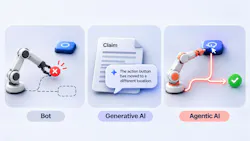
Automation tools have evolved to reduce the need for manual intervention. Traditional automation has helped dental practices eliminate many repetitive administrative tasks. Scripts and bots can follow predefined instructions to complete routine processes. For example, consider a bot programmed to enter a payer portal and download an explanation of benefits (EOB). As long as the portal looks and functions exactly as expected, the process works. However, if the payer changes the location of a button, modifies its login requirements, or introduces an unexpected error, that same bot may be unable to complete its assignment. This now requires someone from the billing team to investigate the interruption and determine how to proceed. As Dalton Knoderer, vice president of sales at Zentist, explains, “A bot was programmed to do something specific on your computer, and it’s not very tolerant of changes.”
Generative AI is useful for interpreting information, recognizing patterns, and explaining complicated situations in understandable language. For example, a generative AI system might review a rejected claim, identify a missing procedure code, and recommend a correction.
However, understanding the problem and completing the necessary steps to resolve it requires different capabilities. This brings us to agentic AI, which combines those capabilities together by allowing software to evaluate a situation, determine an appropriate course of action, and execute tasks within established boundaries. An agentic AI agent navigating a payer portal can recognize that a familiar button has moved and continue working toward its assigned objective. Because payer portals and clearinghouses generally have no API, this work happens through a login screen, the same way a person does it, which is why an agent that can operate the portal itself matters.
How agentic AI addresses dental claim rejections
Claim rejections illustrate some of the most persistent inefficiencies and frustrations in dental RCM. A rejected claim may be due to incorrect subscriber information, missing attachments, procedure coding errors, or discrepancies between the practice management system and the information maintained by the payer. Identifying the rejection is often straightforward, whereas resolving it can require several additional steps.
For agentic AI agents to operate effectively, they need access to the information surrounding the claim. They are also only as effective as the amount of historical data and access they are given. Without that history, an automated system risks repeating work already completed or recommending a correction that previously failed.
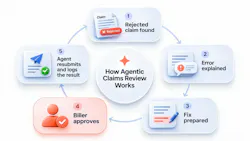
At Zentist, the Caviar platform incorporates this approach through Agentic Claims Review, which is now live. The system checks for rejected claims across participating offices, retrieves the rejection information and claim history, and presents an explanation directly within the claim. For 15 supported rejection types, including subscriber information discrepancies, patient mismatches, ZIP code validity, required attachments, and certain procedure or charge-line errors, Caviar can prepare the correction for the biller to review and approve. Once approved, the agent resubmits the claim in the payer portal and records the result on the claim. For situations that require direct human involvement, the system identifies the information or action needed so the billing team can address the issue without having to reconstruct the entire claim history.
Balancing AI automation with human oversight in dental RCM
The ability to automate increasingly complicated workflows creates important questions about how much independence an AI agent should have. Dental practices and DSOs are responsible for all decisions made throughout the revenue cycle. As automation assumes more responsibility, organizations need clear visibility into the actions being taken and opportunities to intervene when professional judgment is required.
Within Caviar, claim corrections are presented for human approval, and actions are documented in the claim’s activity history. This allows billing professionals to review what occurred, understand the proposed correction, and maintain control over the submission process. Similar principles apply to other automated RCM workflows, where configurable rules and traceable actions help organizations maintain oversight as technology takes on additional responsibilities.
The appropriate level of autonomy will vary depending on the task. Retrieving an EOB presents a different level of risk than modifying claim information or making decisions that affect financial records. Practice leaders should evaluate those differences when deciding which processes can operate independently and which require review. Knoderer puts the goal simply: “You want to use AI and these agents to save people time.”
Automating dental insurance payments and remittance processing
Insurance payments introduce another collection of administrative challenges, particularly for practices still receiving paper checks or virtual credit card payments. Physical payments must be received, deposited, matched with the appropriate remittance information, and accurately recorded in the practice management system.
Virtual credit cards can carry processing fees of approximately 2-3%, creating additional expenses for practices already managing reimbursement pressures. Zentist’s Remit AI addresses payment posting by automating the retrieval and matching of remittance information. The system has demonstrated the ability to automatically locate and match approximately 90-95% of remittances, leaving a smaller group of exceptions that require additional attention. Those remaining exceptions often involve changed payer portals, expired credentials, or interrupted sessions, which are precisely the situations where more adaptive automation can be useful.
The Vault insurance lockbox automation extends this approach to physical insurance payments. Zentist establishes a dedicated lockbox for a practice or organization and redirects insurance checks to that location, helping connect paper-based payment activity with digital revenue cycle workflows. Practices already using automated payment posting can benefit from connecting these processes to their practice management systems.
Evaluating the financial value of dental RCM automation
The financial value of RCM automation depends heavily on the individual practice. A general dentistry office, specialty practice, and large DSO may have very different posting policies and staffing levels. Even the percentage of insurance payments received electronically can affect how much opportunity exists to improve efficiency. Reducing manual work does not necessarily eliminate a staffing expense. Instead, it gives billing professionals more time to address complex claims, investigate reimbursement discrepancies, and support other revenue-generating activities, adding meaningful operational value.
As agentic AI becomes more capable, dental organizations will have opportunities to reconsider how their revenue cycle operates from beginning to end. The greatest opportunities will likely emerge where disconnected systems have historically slowed the movement of information and payments. Understanding those workflows will help practice leaders determine where automation can deliver measurable improvements while maintaining the oversight needed to protect their organizations’ financial health.
Learn more about Agentic Claims Review in Caviar
Sponsored by: