The 2023 Dental Economics Fee and Staffing Survey
Key highlights from the 2023 survey
-
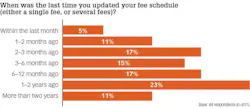
Fee adjustments: 65% of respondents reported updating their fee schedules within the previous year, while 11% had not updated them in more than two years.
-
Staffing shortages: 69% reported difficulty filling dental hygienist positions, and 67% reported difficulty hiring dental assistants.
-
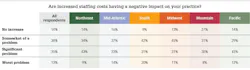
Rising staffing costs: 86% said increased staffing costs had negatively affected their practices, with 48% describing them as a significant problem or their biggest concern.
-
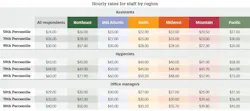
Regional differences: Staffing challenges and employee compensation varied substantially by geographic region and practice location.
-
Payment models: Practices using fee-for-service or membership models generally reported updating their fee schedules more frequently than practices using PPO models.

A practice’s fee schedule is an important tool for long-term financial growth and sustainability. Economic and financial concerns have been at the top of our readers’ minds since 2020. To help our readers understand where they fall—and if they need to take action—we surveyed our audience not only about their fee schedules, but also about their staffing costs and challenges, as these have become even more significant pressures on practices in the last two years.
Survey overview
The majority of respondents (58%) practice in suburban locations, while 23% are in urban locations and 19% are in rural locations. Nine in 10 respondents (91%) have a single location, with multilocation doctor-owned coming in at 8% and DSO at 2%. Respondents are located across the United States.
- Midwest: 27%
- South: 25%
- Mid-Atlantic: 19%
- Pacific: 14%
- Northeast: 8%
- Mountain: 6%
Our methodology
Methodology, data collection, and analysis were performed by Dental Economics and Endeavor Business Intelligence, in conformation to accepted marketing research methods, practices, and procedures. We collected data between March 31 and May 8, 2023, by reaching out to our database of subscribers through emails and links in our newsletters. The total number of respondents was 825.
Overview of findings
Nearly half of respondents (48%) have updated their fee schedule within the past six months. Sixty-five percent have updated their fee schedule within the past year.
Eighty-five percent of respondents use a fee-for-service model, while 64% use a PPO model. Twenty-four percent use a patient membership model.
While the overwhelming majority of our respondents were single-practice owners, we did notice that multipractice locations were much more likely to have recently updated their fee schedules. A full 12% of single-practice locations had not updated their fees in two or more years, while this number was only 6% for multilocation practices. Multilocation practices were the most likely to have updated their fee schedules within the last six months.
Update frequency also differed by practice model. Practices that described themselves as using a fee-for-service or membership model also updated their fee schedules more frequently than those using a PPO model. Note that respondents were allowed to select more than one payment model.
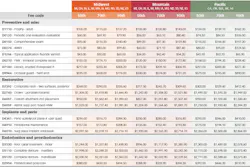
To give readers a better idea of our results, we broke down each fee into 50th, 70th, and 90th percentiles. For the 70th percentile, for example, this means that the fee is in the top 30% of all fees respondents shared with us.
For more insight into what practicing dentists should be doing with this data, I spoke with Dr. Pamela Maragliano-Muniz, chief editor of Dental Economics, and Dr. David Rice, chief editor of DentistryIQ, one of our sister publications.
The effect of payment model on fee updates
The question of when to update fees, especially if a practice relies primarily on PPOs, can seem tricky. Why bother changing a fee schedule when you won’t get paid any more from insurers? But this kind of thinking can actually backfire for practices and the profession as a whole, says Dr. Rice.
“There are major issues for PPO practices not updating their fees; the same is true when they update them but don’t bill out the upgrade, instead billing out what the PPO pays,” says Rice. “That unfortunately does two things: it directly impacts their reimbursement as the insurance company works off what one charges for real versus what they’d planned on paying and it almost always indirectly impacts every practice within an X-mile radius (not sure on the actual number-guessing since it varies) ... meaning the practices who submit lower numbers drag everyone in their area down with them.”
“Every PPO practice needs to understand this principle and how to run their software to account for the write-offs,” he advises. “It’s partly a process thing, and it’s partly an emotional thing. Somehow if they don’t see the massive write-offs, they feel better.”
Dr. Maragliano-Muniz also sees issues with PPO practices being slower to update their fee schedules.
“Many dentists are slow to raise fees and use insurance reimbursements to guide their fee schedule. Dentists are encouraged to charge ‘a little more’ than what insurance companies will reimburse, as charging an equivalent amount, or less, will never encourage insurance carriers to raise their reimbursement,” she says.
“That brings up a philosophic question,” she adds. “If we are slow to raise our fees, maybe we are part of the reason for such poor reimbursement that hasn’t been significantly increased since the 1980s.”
How often to update your fees
“I update annually,” says Dr. Rice. “I feel like many who update more frequently do so for a few reasons—an event like COVID; they haven’t updated for many years and they’re trying to ease the numbers up where they belong; or they just hired a consultant who instructed them to do the above. I highly recommend practices have a process to assess and update their fees every fall for the following year.”
Dr. Roger Levin, a leading practice management expert, also recommends annual updates. “Successful businesses understand that they have to increase pricing each year to maintain profit margins. For dental practices this means increasing fees annually and I suggest that the increase be approximately 5% to keep up with the current effects of inflation. Otherwise, practice profit margins will decline,” he told Dental Economics.
Dig deeper: A strategic way to raise your fees
He also cautions that submitting new fee schedules to insurance is a vital part of the process. “It is also essential to submit the increased fee schedules annually to dental insurance companies in which a practice participates giving them an opportunity to raise the practice fee profile or reimbursements. There are no guarantees, but insurers raise fee profiles occasionally.”
“Either way, the fee increase must offset overhead increases or total practice profitability will decline,” he concludes. “Being proactive about raising fees to keep up with inflation is an important component of practice success.”

Staffing concerns
Filling dental hygienist and assistant positions is still challenging for most respondents. A majority find it difficult to fill dental hygienist (69%) and/or dental assistant (68%) positions. Nearly one in three (31%) have difficulty filling office manager positions.
Staffing costs are putting strain on dental practices. Eighty-six percent of respondents have been negatively impacted by increased staffing costs. Forty-eight percent of respondents indicate increased staffing costs have been a significant problem or their biggest concern.
Across the United States, the difficulty of filling each position varies. Overall, the Northeast appears to be the most challenging environment for all three positions (hygienist, assistant, office manager), with the staffing shortage the least pronounced in the South. However, respondents in the South were the most likely to say increased staffing costs were negatively impacting their practice more than anything else.
“The effect of the staffing shortage on practices is hard to overstate,” says Dr. Maragliano-Muniz. “The obvious way, and most trackable way, is a reduction in practice profitability. The reason for this is multifaceted: the lack of dental hygienists has impacted the number of patients who can be seen in the practice, timeliness of care … and if dentists are providing preventive services, it significantly impacts overall production.”
“The lack of dental assistants impacts the practice by affecting the pace in which a dentist can practice and negatively impacts production. A lack of front office staff and managers will harm overall operations and communication with patients,” she continues. “This can dramatically impact timeliness of care, the ability to fill last-minute schedule changes, management of the team, compliance issues, and upholding production and practice goals.”
Dr. Rice also sees a direct connection between the staffing shortage and decreased collections. “The average dental practice is down 10%-ish in collections this year. Some think patients learned their lesson during the pandemic and did all their untreated work,” he notes. “There’s a bit of truth to that, but it’s not that the dentistry isn’t there to do; it’s that practices are short-teamed and therefore cannot keep up the pace a full team would allow. This workforce shortage has a direct impact on practice performance.”
How do you compare?
As you plan for 2024, don’t hesitate to take a look at your fee schedule and staff wages and ask yourself how it stacks up to others in your region. Is it serving your needs, and your patients’? While dentistry has historically weathered economic downturns well, in a highly inflationary environment, practices that aren’t keeping up with fee updates risk being left behind.
Keep learning: Why you need to raise your fees
Download the full 2023 Fee and Staffing Survey
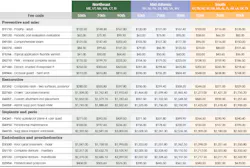
Want to explore the data in more detail? Download the complete Dental Economics Fee and Staffing Survey report, including procedure fee tables organized by region, payment model, and practice location, plus employee compensation data and staffing comparisons.
Fees by region
About the Author
 Amelia Williamson DeStefano, MA
Amelia Williamson DeStefano, MA
Market Content Director
Amelia Williamson DeStefano, MA, is market content director of Endeavor Business Media’s Dental Group, where she leads content strategy for Dental Economics, RDH, and DentistryIQ. With a background in editorial leadership and audience development, she focuses on delivering clinically relevant, evidence-based content that supports better patient care and stronger practice outcomes. She holds a master’s degree in English literature from the University of Tulsa.